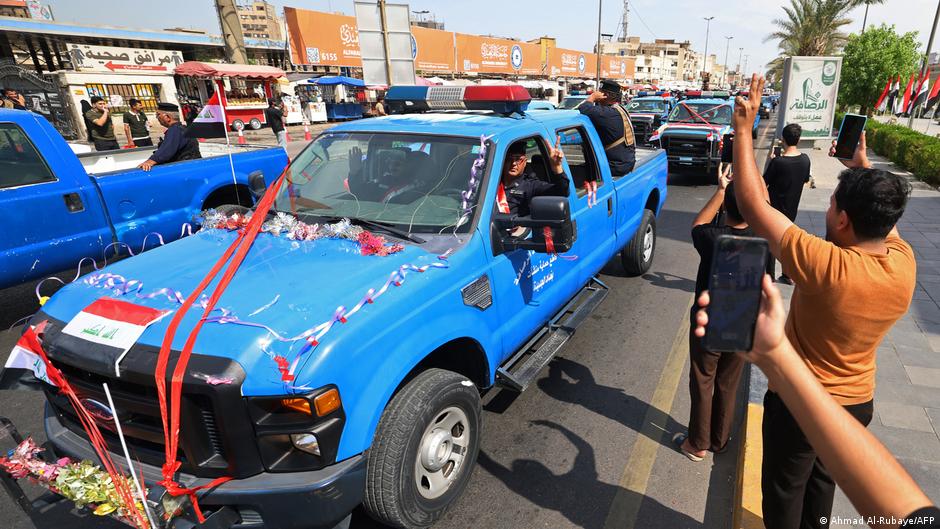
The end of the US military mission in Iraq has created a dangerous security vacuum for the semi-autonomous Kurdish region. Politicians in Baghdad celebrated the withdrawal, with Iraqi Prime Minister Ali al-Zaidi officially declaring October 1 a "Day of Sovereignty and Independence." Tehran, the Islamic Revolutionary Guard Corps (IRGC), and Iranian-backed Shiite militias also cheered the move. But in Erbil, the capital of Iraq's Kurdish region, the mood is markedly more anxious.
Having relied on Washington's protection for two decades, the Kurdistan Region of Iraq (KRI) now faces intertwined crises, including mounting pressure from Baghdad to centralize power and escalating military threats from its neighbors, most notably Iran. To view this video please enable JavaScript, and consider upgrading to a web browser that supports HTML5 video The immediate threat to the Kurdistan region isn't a full-scale military invasion, but rather a slow, calculated chipping away of its autonomy, said Hesam Dastpish, a Middle East analyst based in Brussels. He describes Tehran's overarching strategy toward Erbil as hostile and heavily focused on containment.
The Islamic Republic ultimately wants to strip the KRI of its political clout, reducing it to a purely administrative body, the expert stressed. "Tehran's goal is to turn the Kurdistan region into an institution with absolutely no room to maneuver," Dastpish told DW, pointing to Iran's repeated strikes in the region, supposedly targeting camps of Iranian Kurdish opposition groups. Salahuddin Khadiw, a political analyst based in Mahabad in Iran's Kurdish region, said that neighboring states don't necessarily want to wipe out Kurdish autonomy completely.
Instead, he underscored, Tehran envisions a "controlled and weak" Kurdistan. By dealing separately with the rival power centers in Erbil and Sulaymaniyah, he argued, Iran has maintained influence across the KRI while seeking to prevent any single Kurdish authority from emerging as a dominant power on its western border. Despite the external challenges, the Iraqi Kurdish region's most critical vulnerability comes from within.
The legacy of the 1990s civil war lives on through the deeply entrenched rivalry between the two main ruling factions: the Kurdistan Democratic Party (KDP) and the Patriotic Union of Kurdistan (PUK). Hiwa Mahmoud Osman, an analyst on Iraqi and Kurdish affairs in the Middle East, pointed out that Tehran leans heavily on this internal friction. "Iran has spent decades mastering political influence inside Iraq," he told DW.
"The Kurds' biggest hurdle is their own fragmentation. Without a united front, foreign powers simply have more room to operate." Ardeshir Pashang, a Middle East researcher in Tehran, warned that if Kurdish leaders fail to patch up their political quarrels, this disunity could ultimately lead to the collapse of the Kurdistan region as a political entity. A particularly thorny issue is the presence of Iranian Kurdish opposition outfits taking refuge in the KRI.
Extract — continue reading at the source.