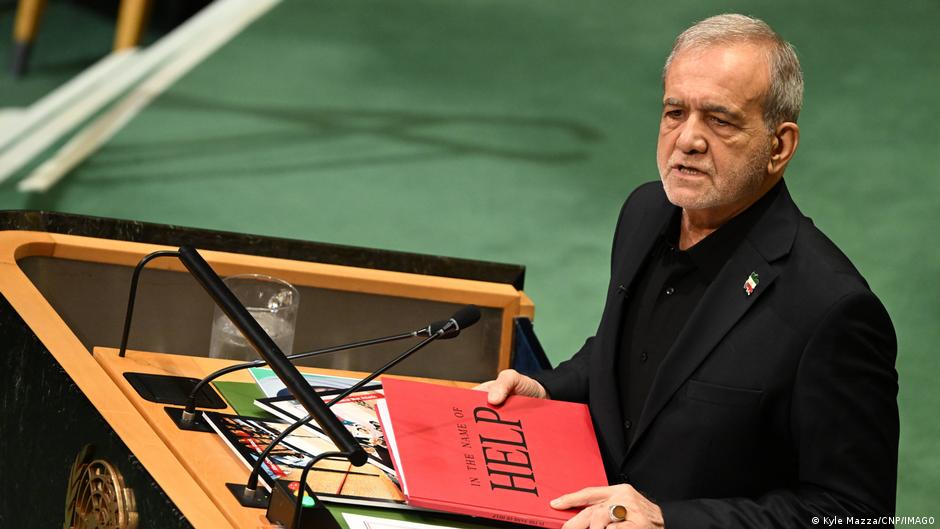
Iranian President Masoud Pezeshkian, who travelled to New York to attend the UN General Assembly, met with American journalists and media representatives. In an interview with the conservative US broadcaster Fox News, he signaled a willingness to make concessions in the nuclear dispute with the United States. Washington has made clear that Iran must never be allowed to possess nuclear weapons.
Asked whether Iran was prepared to hand over its highly enriched uranium, Pezeshkian said his country would comply with its obligationsunder international law and the Nuclear Non-Proliferation Treaty. In its most recent assessment, the International Atomic Energy Agency (IAEA), estimated that Iran had more than 440 kilograms of uranium enriched to up to 60%. Since the US-Israeli attacks on Iranian nuclear facilities in 2025, Iran suspended its cooperation with the IAEA.
The agency has continued to demand access to Iranian facilities and updated information on its nuclear stockpile and the whereabouts of its nuclear material. Asked point-blank "Do you want a nuclear bomb or not?" during the exclusive interview on Fox News' "Special Report," Pezeshkian firmly rejected the premise. Our martyred, esteemed supreme leader had announced several times that, from a religious decree, it is unholy.
It is illegal," he told Bret Baier, referencing religious edicts issued against weapons of mass destruction. Despite Pezeshkians claims, the IAEA has assessed that Iran's fissile material is being enriched far beyond what is needed for civilian use. To view this video please enable JavaScript, and consider upgrading to a web browser that supports HTML5 video A major breakthrough in the conflict between Iran and the United States is not expected anytime soon, Iran expert Arman Mahmoudian, a lecturer in Middle East Studies at the University of South Florida, told DW.
"Pezeshkian does not have the authority to initiate comprehensive de-escalation with the United States. In particular, hardliners and the Islamic Revolutionary Guard Corps (IRGC) appear to continue to wield considerable influence over Iran's decision-making process," he added. Nevertheless, Mahmoudian thinks Pezeshkian's visit could help establish a more direct channel of communication between Tehran and Washington.
He also sees the possibility of creating a framework for future negotiations in New York, adding that the two sides could develop a roadmap that would pave the way for more substantive talks and, in the longer term, potentially contribute to de-escalation. There are already signs of this, including meetings between Iranian and US delegations earlier this week. The White House, meanwhile, confirmed that "positive and constructive" talks were continuing through intermediaries.
Extract — continue reading at the source.