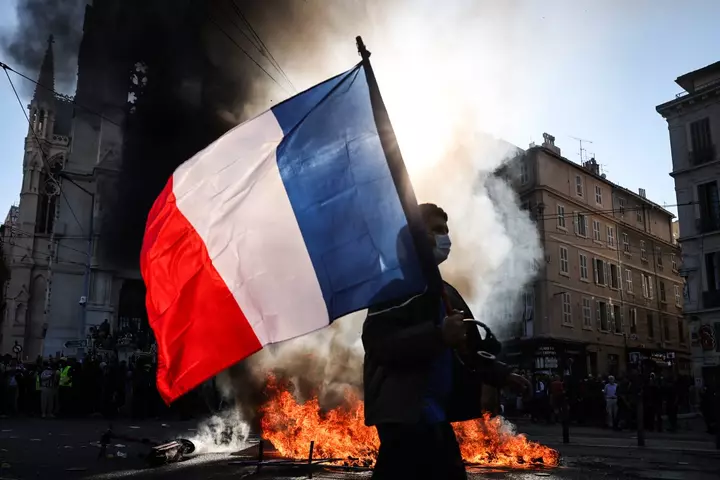
France’s social and fiscal fabric appears to be fraying as its public and political classes stare down a nexus of issues that seem set to alter the trajectory of La République. Protests have enveloped the country since September, originally sparked by concerns over school staffing and funding but since fueled by a mix of broad economic woes and generational unrest. And the timing could not be more combustible politically speaking, with budgetary debates and an upcoming presidential election turning what might have been a typically French episode of youthful agitation into a consequential clash—between protesters and heavy-handed riot police, but also between competing visions for France’s future.
Amid this, outside observers have labeled the country varyingly as “on the brink,” in the “eye of the storm” and as the “economic sick man of the Western world,” as netizens have linked its current woes to a question asked by Lukas Matsson in season 4 of Succession: Though only a “little bit more dramatic” than protests in the past, Fatás said the current unrest was made unique by its combination of social, economic and political catalysts. The student movement began in the Paris suburbs, but has since spread nationwide as concerns over teacher shortages and overcrowded classrooms were folded into broader backlash against social inequality and the rising cost of living. And there is certainly evidence that the existing social contract is not working for segments of French society.
Youth unemployment declined slightly to 20.6 percent in August, according to EUROSTAT, and remains well below the record 28.3 percent in late 2012. But this compares to just 7.4 percent in Germany, 9.1 percent in the United States and 14.4 percent in the U.K. in July. And as further evidence of their social roots, participants from the 2018 Yellow Vest (or “Gilets Jaunes”) have joined in the protests and framed these school-related issues as complementary to their concerns over regional and class inequality and the policies of President Emmanuel Macron.
While the clashes are frightening and the political ramifications significant, the “fiscal crisis” at the heart of this “is the most dangerous” according to Mujtaba Rahman, managing director for Europe at Eurasia Group, who in an op-ed for The New York Times wrote that France had been brought to “the brink” by years of budgetary mismanagement by Paris. While comparable to other advanced economies, Rahman said France’s debt-to-GDP ratio remains a cause for concern, as do its “surging” borrowing costs and the amount spent on education relative to the rest of Europe. As he notes, the country spends roughly $100 billion each year on education—over a quarter of which goes toward paying retired teachers’ pensions.
This perceived mismanagement prompted Paul Krugman, winner of the 2008 Nobel Prize in Economics, to describe France as on a “fiscally unsustainable path.” “France is effectively handing over large subsidies to older French at the expense of everyone else,” he wrote in a blog earlier this month. The relatively austere spending plan unveiled by Prime Minister Sébastien Lecornu on October 1 targets €54 billion in savings ($60.5 billion), but must navigate a fractious parliament and public frustrations over spending. The country has been “the hardest hit in the global bond sell-off,” according to a report from Allianz, and this has seemingly been exacerbated by the protests themselves.
And Zsolt Darvas, a senior fellow at Bruegel, told Newsweek that another “impasse” over its current budget “could further unsettle bond markets and put additional upward pressure on yields.” These cyclical economic and social stimulants have combined at a particularly volatile political moment. The 2024 election produced a hung parliament and split the legislature among competing blocs, making stable governance and financial reform an even taller task. Macron’s departure in May will also leave the political center without an obvious heir, and the riots are therefore being viewed as something of an inauguration for France’s far right.
Extract — continue reading at the source.