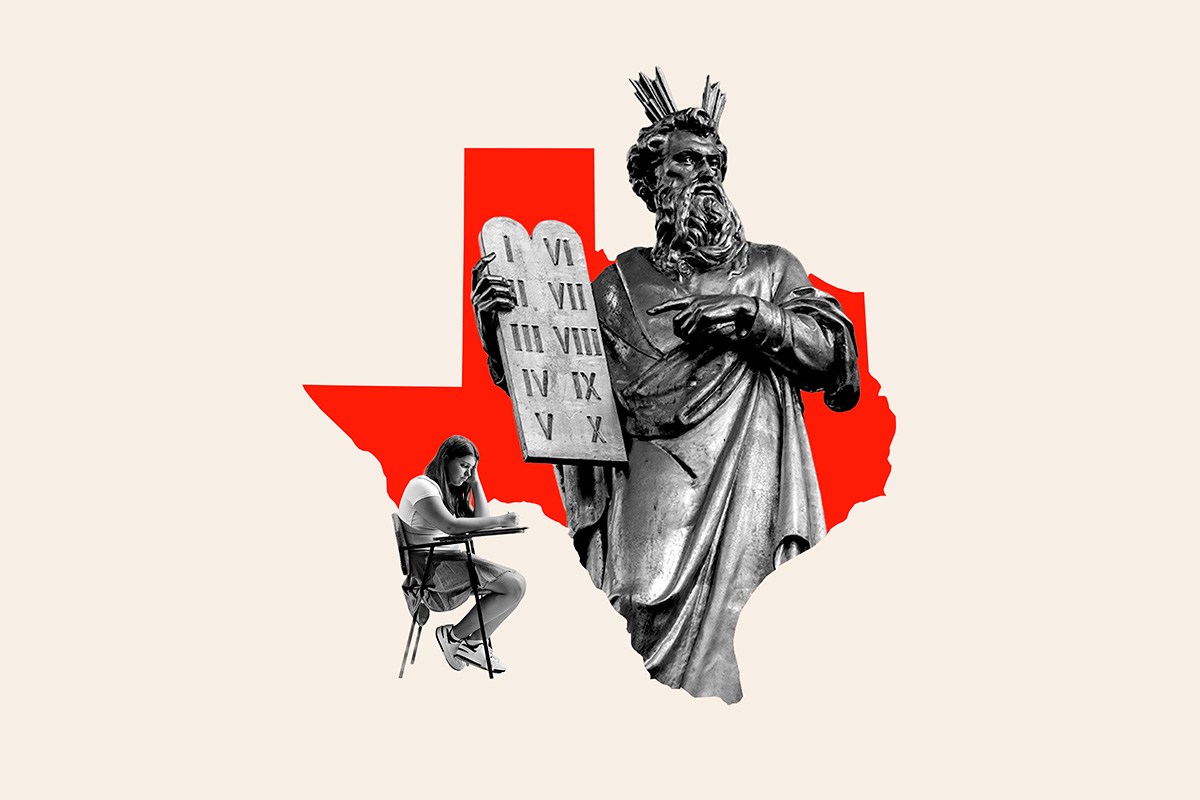
Texas lawmakers have required the Ten Commandments to be displayed in public school classrooms, a mandate now tied up in litigation and asking a practical question of an ancient religious text: how large should Sinai be? Under the law, the answer is at least 16 by 20 inches, displayed conspicuously and readable from anywhere in the room. Millennia after Moses came down the mountain with stone tablets, Texas has added the poster specifications.
The legal fight has now reached the Supreme Court, where challengers in Nathan v. Alamo Heights Independent School District are asking the justices to take up the case. Supporters say displaying the Ten Commandments gives students moral clarity and grounds them in American history.
Lead plaintiff Rabbi Mara Nathan sees the matter differently: religious beliefs, she said, should be instilled by “parents and faith communities, not politicians and public schools.” The dispute is unfolding in a state that is deeply religious but hardly religiously uniform: 27 percent of Texas adults identify as evangelical Protestants, while another 26 percent are religiously unaffiliated, according to Pew’s 2023–24 Religious Landscape Study. At first glance, then, this looks like a familiar church-and-state fight. But zoom in on the poster itself.
If the Ten Commandments are important enough to mandate, they are important enough to take seriously, including their warnings about using God’s name for unworthy purposes, making idols, bearing false witness and coveting what belongs to someone else. Texas wants the commandments to judge the classroom—but perhaps they have something to say about Texas? Start with the obvious one: “Thou shalt not take the Name of the Lord thy God in vain,” one of the lines Texas specifically requires schools to display.
The law does not merely permit schools to post the commandments; it prescribes their wording, dimensions and visibility. The required text begins with a declaration of God and commands that no other gods be before Him. Today, taking God’s name “in vain” is commonly understood as a ban on profanity.
The older religious idea is broader: God’s name should not be invoked falsely, frivolously or for purposes unworthy of it. Therein lies the first problem for Texas. The state is invoking God’s words to accomplish a political and civic purpose.
Extract — continue reading at the source.