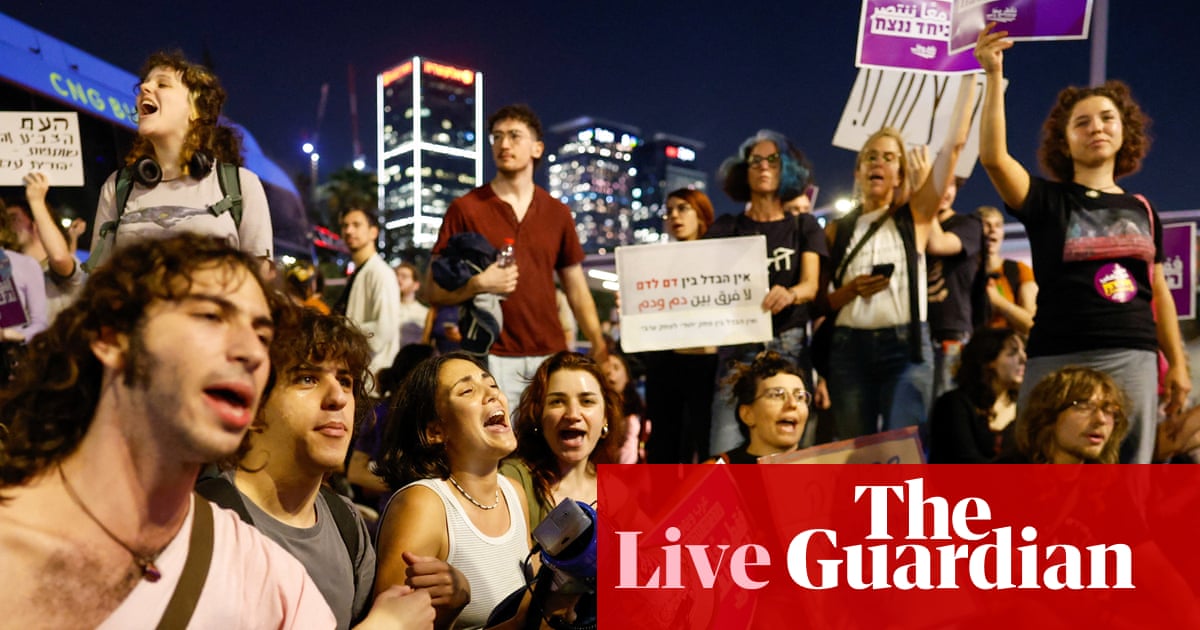
Hello and welcome to our continuing coverage of the Israeli election. With 91% of votes now counted, the current results show prime minister Benjamin Netanyahu’s bloc projected to receive 53 seats, with the grouping of his opponent Gadi Eisenkot on 48 and the Palestinian parties on track to receive a record 19 seats. The final tally of absentee ballots is not expected to significantly shift the results, and with no grouping managing to reach the 61 seats needed for a majority in the Knesset, Israel could be in for weeks of uncertainty, as both sides try to gather enough support to form a government.
Yair Golan, the leader of the centre-left Democrats, a junior partner in Eisenkot’s bloc, has told Israeli media that he will meet leaders on Thursday for coalition talks. According to the Times of Israel, he will hold talks with Eisenkot, the leading opposition candidate and chair of the Yashar party, and Yair Lapid, the number-two in the opposition B’Yachad party. This would mark the official start of coalition talks, and Golan has been the only opposition leader so far backing working with the parties led by Palestinian citizens of Israel.
Israel’s president, Isaac Herzog, voiced hope that the country could avoid a second election. Israel’s future hangs in the balance after it became clear that Benjamin Netanyahu has lost his governing majority. His political fate now depends on whether opposition Jewish parties are prepared to forge a common front with Palestinian parties, whose support surged in Tuesday’s historic elections.
Indeed, Gadi Eisenkot and his allies face a clear choice: either make a pact with Arab Israeli parties heading for a record result of 19 seats, or hand Netanyahu a political lifeline in the form of new elections or a unity government. Yousef Jabareen, head of the Arab-majority Joint List, said the Israeli public had voted for new leadership and “anyone who wants to offer a substantive and genuine alternative to Netanyahu’s blood-soaked government will have to talk to us”. He told that while he was willing to cooperate with an opposition-led government to unseat Netanyahu, he was not open to joining such a coalition outright.
The ad hoc support of Palestinian lawmakers could enable Eisenkot to maintain a minority government, although few observers believe such an arrangement would survive for long. Israel’s Central Elections Committee said it had received a Likud party complaint alleging that Arab parties had compromised election integrity and would examine the claims as part of its routine post-election review. Netanyahu’s party responded to partial election results showing Arab-led parties could play a king-making role in forming a new government by accusing them – without evidence – of “stealing” the election and demanding that the police and Shin Bet security service investigate the allegations.
UN rights chief Volker Turk has said that he hopes the next Israeli government will “change course massively” and respect international law. He added: “Israel has its obligations under international law, international humanitarian law, international human rights law, and they need to respect them, and I hope that the next government will do precisely that and change course massively.”
Extract — continue reading at the source.