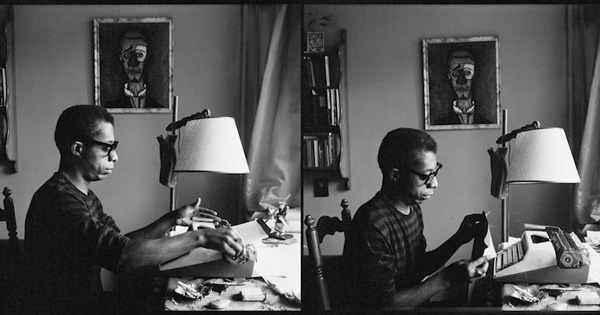
In 1989, Paris Review founding editor and trailblazing interviewer George Plimpton edited a wonderful collection titled The Writer’s Chapbook: A Compendium of Fact, Opinion, Wit, and Advice from the 20th Century’s Preeminent Writers (public library). Among them was novelist, poet, essayist, and playwright James Baldwin (August 2, 1924–December 1, 1987), whom Plimpton had interviewed on two separate occasions in early 1984, half a century after Baldwin read his way out of Harlem and into the pantheon of literary greatness. In a fantastic addition to the collected wisdom of celebrated writers, Baldwin looks back on his formidable career and shares what he has learned about the creative process, the psychological drivers of writing, and the habits of mind one must cultivate in order to excel at the craft.
Reflecting on what motivates great writers to write — an enduring question also addressed beautifully by George Orwell, David Foster Wallace, Italo Calvino, and William Faulkner — Baldwin sides with Bukowski and argues that the supreme animating force of the writer is the irrepressible impossibility of not-writing: Something that irritates you and won’t let you go. That’s the anguish of it. You have to go through that.
I know a lot of talented ruins. Beyond talent lie all the usual words: discipline, love, luck, but most of all, endurance. Endurance, indeed, is perhaps the sole common denominator among successful authors.
Any aspiring writer, he admonishes, should have no illusion about the endurance required but should want to write anyway. A generation after Jack Kerouac considered the vital difference between talent and genius, Baldwin notes: If you are going to be a writer there is nothing I can say to stop you; if you’re not going to be a writer nothing I can say will help you. What you really need at the beginning is somebody to let you know that the effort is real.
In a sentiment reminiscent of Joan Didion’s observation that she writes in order to gain better access to her own mind, Baldwin speaks to the consciousness-clarifying function of the creative impulse: When you’re writing, you’re trying to find out something which you don’t know. The whole language of writing for me is finding out what you don’t want to know, what you don’t want to find out. But something forces you to anyway.
Much of that self-revelation, Baldwin points out, happens not during the first outpour of writing but during the grueling process of rewriting. Echoing Hemingway’s abiding wisdom on the crucial art of revision, he adds: Rewriting [is] very painful. You know it’s finished when you can’t do anything more to it, though it’s never exactly the way you want it… The hardest thing in the world is simplicity.
Extract — continue reading at the source.