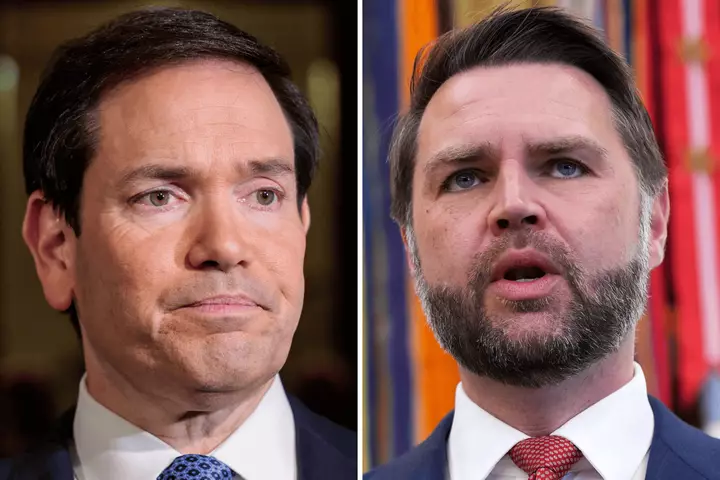
Vice President JD Vance and Secretary of State Marco Rubio have both lost ground in leading the 2028 Republican presidential nomination prediction markets, according to a Newsweek analysis of Polymarket and Kalshi data. Almost $714 million in cumulative trading volume has been recorded on Polymarket’s Republican presidential nominee market, where Vance’s odds have fallen from roughly 53 percent on September 3 to 43.8 percent on Tuesday. Rubio has fallen from 27.8 percent on August 3 to 15.1 percent.
U.S.-regulated prediction market Kalshi tells a similar, yet less dramatic, story, with Vance’s odds falling from 45.8 percent on September 3 to 43 percent, and Rubio’s from 29.5 percent on August 3 to just 18 percent, with almost $70,000 traded. It comes after Vance acknowledged over the weekend that there was “of course” a chance he would not seek the presidency, citing his four young children and his wife’s dislike of politics. The prediction market movement raises an early question about whether Republicans are growing less certain about the party’s post-President Donald Trump succession plan.
But Koleman Strumpf, a professor of economics at Wake Forest University who studies prediction markets, cautioned against overstating the shift. He told Newsweek in emailed comments Tuesday that Vance had fallen by roughly 4 points over the past week, only some of which followed his remarks. Newsweek emailed Vance via the White House and Rubio via the State Department for comment on Tuesday.
Normally, when Vance's odds decline, the chances for Rubio, his presumed rival, increase. But this time, Rubio is also losing ground, while possible alternatives such as Florida Governor Ron DeSantis and commentator Tucker Carlson remain in the low single digits. Strumpf said the lack of a pronounced beneficiary from the latest movement may indicate that traders do not regard Vance’s comments as particularly consequential, rather than a decisive turn against the two leading names.
Republican losses in the November 3 midterm elections could make the administration a liability for prospective successors, Panagopoulos suggested. If the elections prove disastrous for the party and the president, he added, proximity to Trump could turn “from an asset into a liability” for both Vance and Rubio. Panagopoulos said this year's midterms could push the Republican Party in either direction.
One possibility, he said, is that Trump and Republicans “continue to crash and burn” amid declining electoral support, particularly if Democrats capture one or both chambers of Congress. But Democratic victories could also give the administration a political opponent to blame for future setbacks. That calculation could change under divided government, he said, meaning the outlook for administration figures considering 2028 campaigns will depend heavily on what happens in November.
Extract — continue reading at the source.