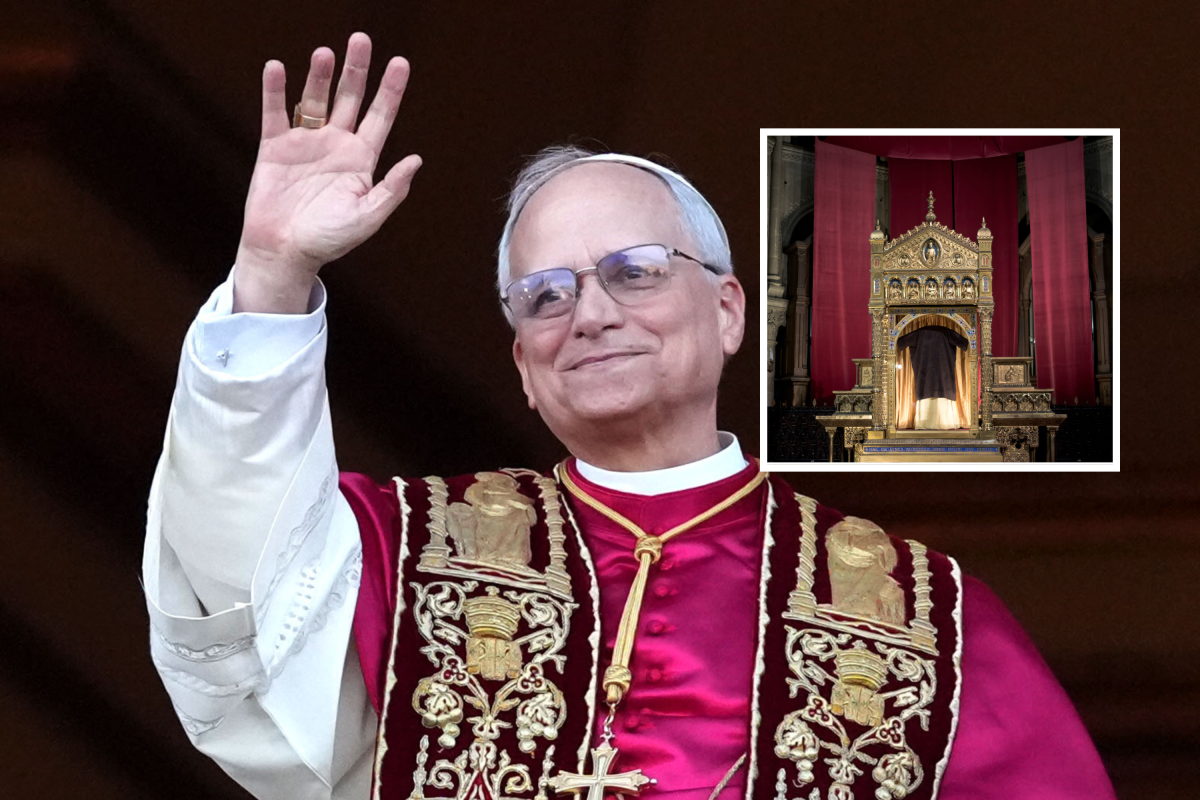
A tunic that some Christians believe was worn by Jesus Christ at his crucifixtion, and is seldom seen in public, is set to be unfurled for Pope Leo XIV on Friday. The Holy Tunic of Christ will be presented to Pope Leo at the Stade de France, a stadium in the north of Paris, where a prayer vigil for young people is set to be held as part of the pontiff’s three-day trip to France. The Diocese of Pontoise, the local Catholic Church authority for the part of France that includes Argenteuil, where the tunic is kept, announced the presentation earlier this month.
It was last displayed to the public from Good Friday, April 18, to May 11, 2025, in the Basilica of Saint-Denys in Argenteuil for an “exceptional exposition,” the diocese said. The tunic will have to travel almost four miles from the Basilica of Argenteuil to Stade de France under tight security, with the exact route being kept secret and both on-the-ground and aerial security measures in place, according to the Catholic media outlet the Eternal Word Television Network (EWTN). These precautions reflect what the garment means to Catholics who venerate it, “classified among the most sacred in Christianity,” as the diocese says.
They also come against the backdrop of the tunic having disappeared for around two months in the 1980s. The tunic was stolen on the night of December 12-13 in 1983 and returned in February the next year, France’s Ministry of Culture records show. It was handed back to Father Guyard, the parish priest of the basilica, who never revealed who had taken it, according to Sainte Tunique, the official website of the tunic’s custodians.
Public records do not say how the tunic was stolen or how it was recovered. The Holy Tunic of Christ, also called the Holy Tunic of Argenteuil, is described as a woolen piece of clothing “stained with human blood” by Sainte Tunique. Sainte Tunique says “numerous scientific studies over time have provided evidence of its authenticity, including the analysis of pollen, weaving techniques, and blood type.” But there is still debate about this among Christians and the scientific community, with France’s Ministry of Culture pointing out that a 2004 radiocarbon analysis dated the garment between AD 530 and AD 650, centuries after Christ’s lifetime.
This in “no way diminishes its historical and heritage value,” the ministry adds. Sainte Tunique acknowledges these results but says: The researchers who conducted the study cautioned that dating from ancient wool or linen fabric can be inaccurate due to historical factors such as water and fire damage, two centuries of being stored within the abbey wall in contact with mold, and the relic's burial in a cemetery during the French Revolution.” According to Sainte Tunique’s account, the Byzantine Empress Irene gifted the Western Roman Emperor Charlemagne the tunic in an effort to secure more western allies at the end of the 8th century. Charlemagne, a Christian, gave the tunic to his daughter Theodrada, who was then a nun at the Monastery of the Incarnation in Argenteuil, where it was later hidden for safekeeping and has long been preserved.
Those who believe it is the garment worn by Christ “at the foot of the Cross” believe it is mentioned in the Bible in John 19:23-24. These verses read: “After the soldiers had crucified Jesus, they took his clothes and divided them into four parts, one for each soldier. They also took his tunic, which was seamless, woven in one piece from top to bottom.
Extract — continue reading at the source.