A federal judge on Tuesday seemed skeptical of a Trump administration request to immediately block California officials from counting about 20,000 ballots from voters whose citizenship the administration questions, but said he would not issue a ruling until Wednesday. Carter questioned how the administration had derived its list of suspect voters, worried about disenfranchising eligible voters, said the demands would represent a “monumental change” to California elections and suggested federal prosecutors bringing the case had other means of holding illegal voters accountable. But just one day after a federal appeals court rejected the same request, Carter said at the conclusion of a 3½-hour hearing in Los Angeles that he needed more time to rule — except on one related issue.
After the hearing, First Assistant U.S. Bill Essayli, the top federal prosecutor in Los Angeles who argued on behalf of the Trump administration, said he had made it “abundantly clear that American voters are being disenfranchised in real time,” and that the administration will wait to see what Carter says Wednesday but was likely to appeal the matter back up to the appellate court. He also denied threatening state officials, despite the Justice Department having sent formal letters to elections officials statewide last week warning them of criminal punishments, and Essayli reiterated that position Tuesday.
Carter’s hearing came after Monday’s decision from the U.S. 9th Circuit Court of Appeals — the reverse of what’s normal — because Justice Department attorneys had tried to go over Carter’s head after he didn’t acquiesce to a deadline they’d set for him to rule on their request for a temporary restraining order against the state last week. However, when the three-judge appellate panel — composed of two appointees of President Trump and one of President Biden — ruled 2-1 Monday that it had no jurisdiction to hear the case given Carter hadn’t yet had the chance, the case returned to Carter’s courtroom. And there, Carter — an appointee of President Clinton — seemed loathe to rush to judgment, despite the Trump administration’s claims of urgency.
He said the administration’s method for arriving at its list of potential noncitizen voters was unclear and that he would like to develop the record further, including by bringing in an expert for the court. How was this derived?” he said. He also seemed unmoved by the Justice Department’s argument that the ballots themselves must be segregated immediately to prevent noncitizen votes from being counted, and more focused on whether noncitizens who illegally vote can be identified and held accountable while avoiding disenfranchising legitimate voters in the process.
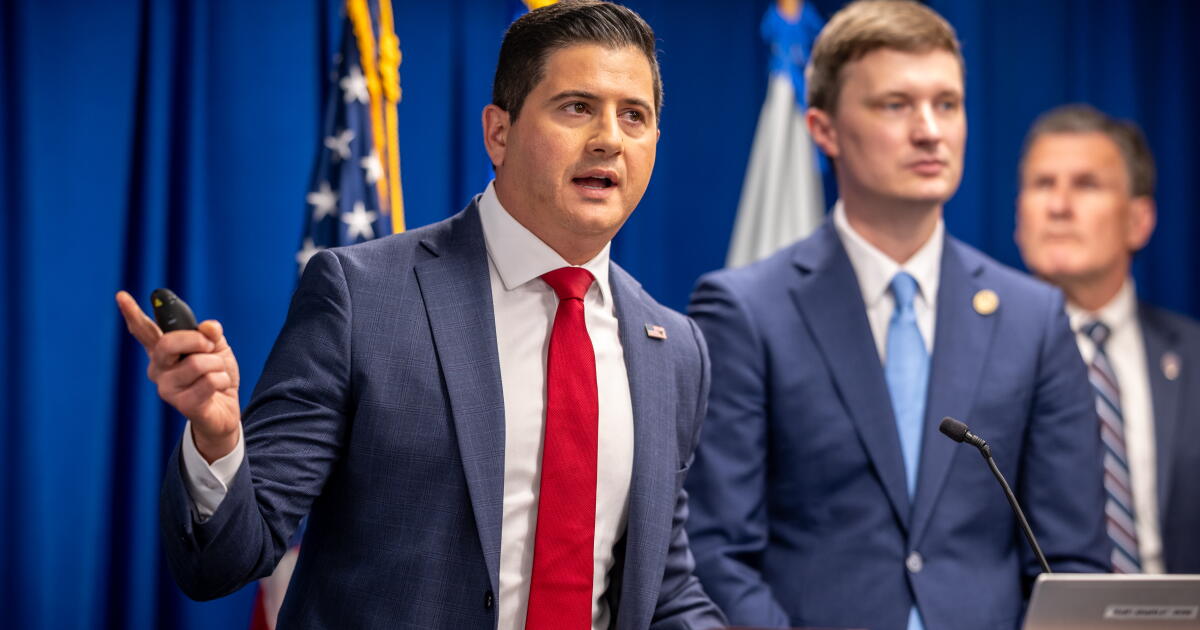
For those who do vote illegally, “you’ve got a remedy, for goodness sakes,” he told Essayli. Trent McCotter gave Weber and Logan 48 hours to set aside the ballots for the 20,000 flagged voters, whom McCotter described as “likely noncitizens.” During the hearing, Essayli argued on behalf of the Trump administration that its demands on California and L.A. County were not onerous, could easily be complied with and do not call for ballots to not be counted.
Essayli said the federal government was in court “on a very narrow request for an injunction to separate ballots of those suspected of being noncitizens” only until the state can prove their citizenship. He argued that the “reliability and credibility” of the federal government process for flagging the 20,000 voters is unquestionable — while also telling Carter, “We’re never going to stand here and tell you that everything is 100%.” He said every vote counts, as some elections “are decided by a handful of votes,” and that the federal government is simply asking California not to break existing federal law barring noncitizens from voting. We’re telling them what they can’t do, which is just count these ballots without doing more to ensure whether they’re citizens or not,” Essayli said.
Extract — continue reading at the source.