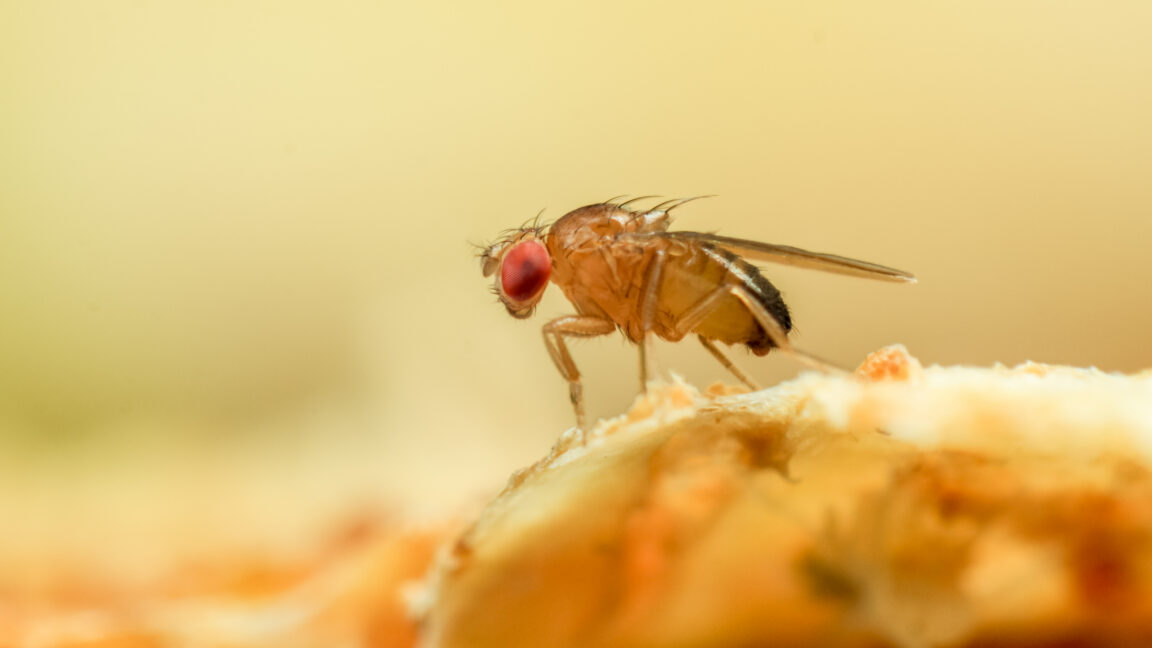
Fruit flies aren’t exactly famous for their brainpower; you’ve probably drowned more than one in a wine glass left too long on the patio table. And yet, working with roughly 140,000 neurons—a brain smaller than a poppy seed—Drosophila can sort through a huge range of smells in a fraction of a second, and then retain the memory of that scent for a long time. In this, they do much better than current “electronic noses.” Even the most advanced ones on the market tend to be expensive, painfully narrow in what they can detect, and quick to forget an odor the moment they learn a new one.
So why not just copy the fly? That’s the question a growing number of researchers have been asking—including Kevin Max and Yang Shen at the Okinawa Institute of Science and Technology, whose new algorithm, Spi-Fly, is described in a paper just published in the journal Neuromorphic Computing and Engineering. Smell is a strange sense, mechanically speaking.
Vision and hearing both reduce to a single physical dimension you can plot on a graph—wavelength—which makes them relatively tidy to study. Odor molecules, by contrast, can’t be reduced to any single physical dimension. Biology had to find a messier solution instead: hundreds of different receptor proteins, each shaped to grab onto specific molecular features, firing in combinations that the brain then has to decode.
It’s a system so combinatorially complex that it took until 1991 for Linda Buck and Richard Axel to even identify the receptor gene family behind it, work that won them a Nobel Prize in 2004. Despite the difficulties in our understanding of smell, “electronic noses” exist on the market. Companies like Alpha MOS, Aryballe, and Odotech sell them for food-quality control, environmental monitoring, and security screening.
Extract — continue reading at the source.