Feelings are central to wellbeing, but measuring them remains difficult: surveys provide reliable data but are burdensome. LLMs introduce a provocative alternative: acting as proxies that articulate emotions and experiences on behalf of individuals. However, little work has systematically evaluated the validity of such an approach, and this is our contribution.
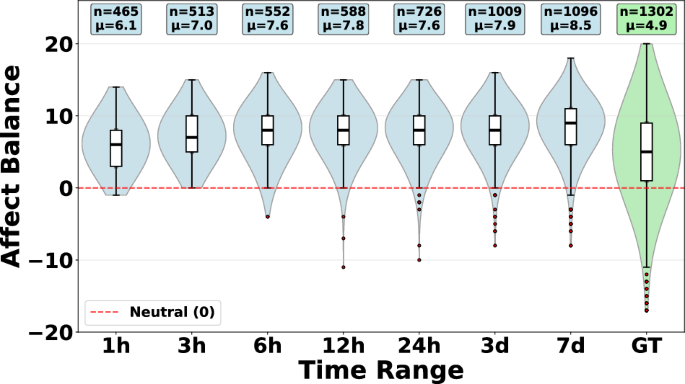
Here, we use longitudinal smartphone data to personalise an LLM (Gemini-2.5-flash-lite) and approximate human responses to an affective survey. Using 17 weeks of multimodal sensing and questionnaires from 83 participants, we evaluate how well an LLM can predict affect across different time ranges, affect types, and individuals. Our findings reveal a systematic positivity bias: the LLM predicts people as happier than they actually report, while downplaying their negative feelings.
This work highlights the importance of rigorous evaluation and affective-science grounding when using LLMs to infer human feelings from digital traces. Humans automatically associate daily events with their feelings, such as inspired and ashamed1,2. These momentary feelings are central to mental wellbeing: they reflect environmental demands, guide behaviour, and motivate self-regulation3,4.
However, measuring affects remains challenging. Surveys can provide reliable and detailed data, but they burden users and fail to support real-time feedback5,6,7,8,9. On the other hand, passive smartphone sensing offers continuous behavioural signals, but it is difficult to translate these signals into subjective experience10.
Prior work has explored predicting affective states from such passively sensed data using machine learning with promising results, but these approaches rely on extensive, hand-crafted feature engineering11,12. Large language models (LLMs) provide a new possibility: by combining survey responses13 with rich digital traces (e.g., smartphone-sensor data), LLMs could simulate or infer individuals’ affects14,15. This capability has the potential for helping users reflect on their feelings without the need to manually answer affective questionnaires.
Given LLMs’ success in reasoning over natural language and contextual information, it is tempting to assume that sufficiently rich personal data might allow them to approximate how people feel in everyday life. However, little is known about how well LLMs can predict human affects16, or whether such predictions are systematically biased17. In this paper, we present the first large-scale study using longitudinal smartphone data to personalise an LLM (Gemini-2.5-flash-lite) and evaluate its ability to simulate human responses to affective surveys (e.g., the Positive and Negative Affect Schedule; PANAS).
Extract — continue reading at the source.