Ageing research has one nearly unshakeable fact: an animal that eats less lives longer. But a lifetime of hunger is neither pleasant nor a realistic human plan. Danica Chen's team at the University of California, Berkeley, asked whether a drug could imitate the effect.
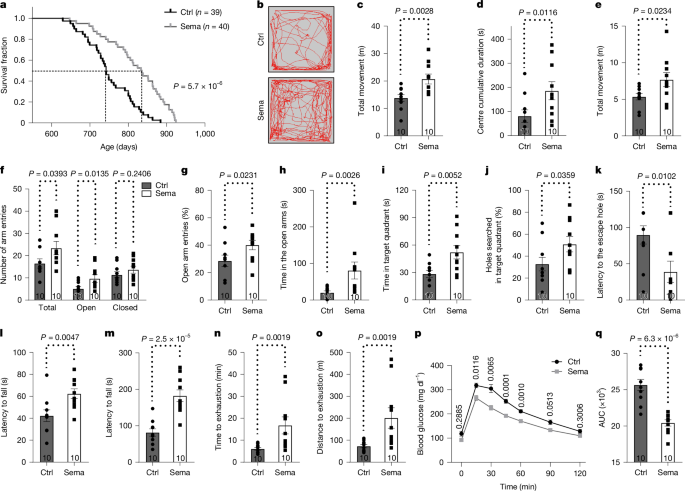
They chose semaglutide, the GLP-1 compound famous as a weight-loss and diabetes drug, and — crucially — started it late, in 20-month-old female mice, roughly a human in their mid-sixties. Mice treated until death had a median lifespan about 100 days longer than controls. The extra time was healthy time: better muscle and cognitive function, lower inflammation markers, weakened molecular signatures of ageing, improved spatial memory, steadier blood sugar.
Compared directly with calorie restriction (24% less food over five months), the drug did more in some areas, especially memory and glucose control. One oddity: calorie-restricted mice slowed their metabolism, while the drugged mice barely changed theirs. Caveats matter: female mice only, and what works in a mouse often fails in a person.
But hundreds of millions of people already take these drugs for other reasons, making this an unplanned natural experiment worth watching. A century-old rule — that the only lever on lifespan is hunger — is being seriously shaken. Source: Feng et al., Nature, 2026 — nature.com/articles/s41586-026-10940-7.
Extract — continue reading at the source.