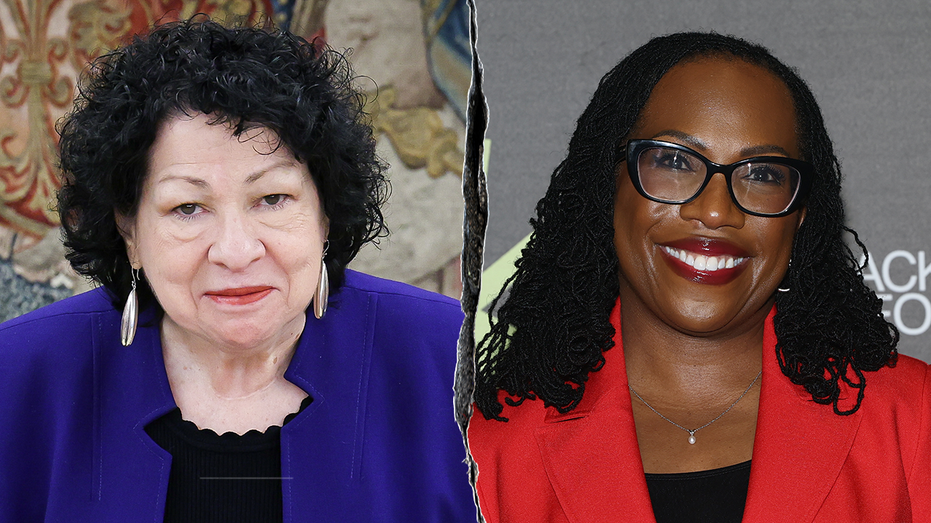
Justices Ketanji Brown Jackson and Sonia Sotomayor's repeated questions concerning whether the Supreme Court has jurisdiction to hear a high-profile climate case that could expose oil companies to lawsuits across the country steered conservative lawyers to believe that the liberal justices are seeking an "off-ramp." "The fact that they kept going back to trying to create a jurisdictional problem tells me they don't feel confident that they have the votes in this space," Carrie Severino, president of JCN, a conservative judicial group, told Fox News Digital. "Jackson and Sotomayor were looking for an escape hatch." The Supreme Court began its new term Monday, hearing its first oral arguments for Suncor v. Boulder, in which they will rule on whether state tort laws can be used to seek damages from oil companies for climate change, even when the alleged harms are occurring outside the state or continent.
The justices will also rule on whether the Supreme Court has jurisdiction to hear this case now, as the case is still before the Colorado Supreme Court. The case before the high court is in an unusual procedural posture, meaning the justices could resolve it without ever reaching the blockbuster state-versus-federal power fight at its center. That dispute centers on whether Colorado can use its own laws to seek damages for alleged harms caused by emissions from other states or whether it's an issue for the federal government and Congress to regulate.
SUPREME COURT BEGINS NEW TERM WITH HIGH-PROFILE LOOK AT CLEAN AIR AND FEDERAL AUTHORITY "The questions by Jackson and Sotomayor trying to say it would be premature for the court to issue an opinion are simply the liberal justices trying to find an off-ramp for the case because they are afraid they will be outvoted on the main issue: does federal law such as the Clean Air Act preempt all state claims like those asserted here," Hans von Spakovsky, senior legal fellow with Advancing American Freedom, told Fox News Digital. While questioning Suncor attorney Kannon Shanmugam, Jackson suggested the dispute may have reached the Supreme Court too soon, calling it "premature from the standpoint of this court exercising its jurisdiction." She also repeatedly questioned why the court couldn't wait to hear the case, saying the court doesn't "have the whole set of facts" and that the court doesn't "really know enough to be confident" that the theories posed are applicable. "It feels to me like the defendants ... are bringing it back to federal court before the state courts have really had a chance to sort out who is the source, what is their allegation with respect to how this causation is happening," Jackson told Principal Deputy Solicitor General Sarah Harris, who argued in support of Suncor.
Meanwhile, Sotomayor refused to drop her line of questioning on jurisdiction with Shanmugam, proposing that the Supreme Court send the case back to the Colorado Supreme Court. "If we're unsure of your characterization, because there's certainly a number of amici brief who disagree with that characterization, shouldn't we be certifying this question to the Colorado court instead of us deciding it? We have to be sure of our jurisdiction before we take it," Sotomayor said.
Republican Alabama Attorney General Steve Marshall told Fox News Digital it was clear that the liberal justices were trying to cast doubt on whether they have jurisdiction. SUPREME COURT CAN RESTORE SANITY AND STOP THE LEFT’S RADICAL CLIMATE AGENDA "Well, I think you saw both Justice Jackson and Justice Sotomayor try to find an out for this court, basically saying the court doesn't have jurisdiction at this stage of the case to be able to make a final ruling. I think that you saw the advocates on behalf of Suncor be able to distinguish that." If the Supreme Court declines to reach the federalism issue, the Colorado Supreme Court's ruling allowing Boulder's state-law claims to proceed would remain in place, leaving the broader question of how far states can use tort law to pursue climate claims against energy companies unresolved.
Chief Justice John Roberts pressed Boulder attorney Kevin Russell on whether a Boulder win could trigger similar lawsuits nationwide. Russell said there are legal limits, but acknowledged to Justice Clarence Thomas that Boulder's theory could allow other fossil-fuel businesses to be sued. "The chief justice and the court do not like issuing rulings with no limiting principles, rulings that could open up unlimited litigation and claims.
Extract — continue reading at the source.