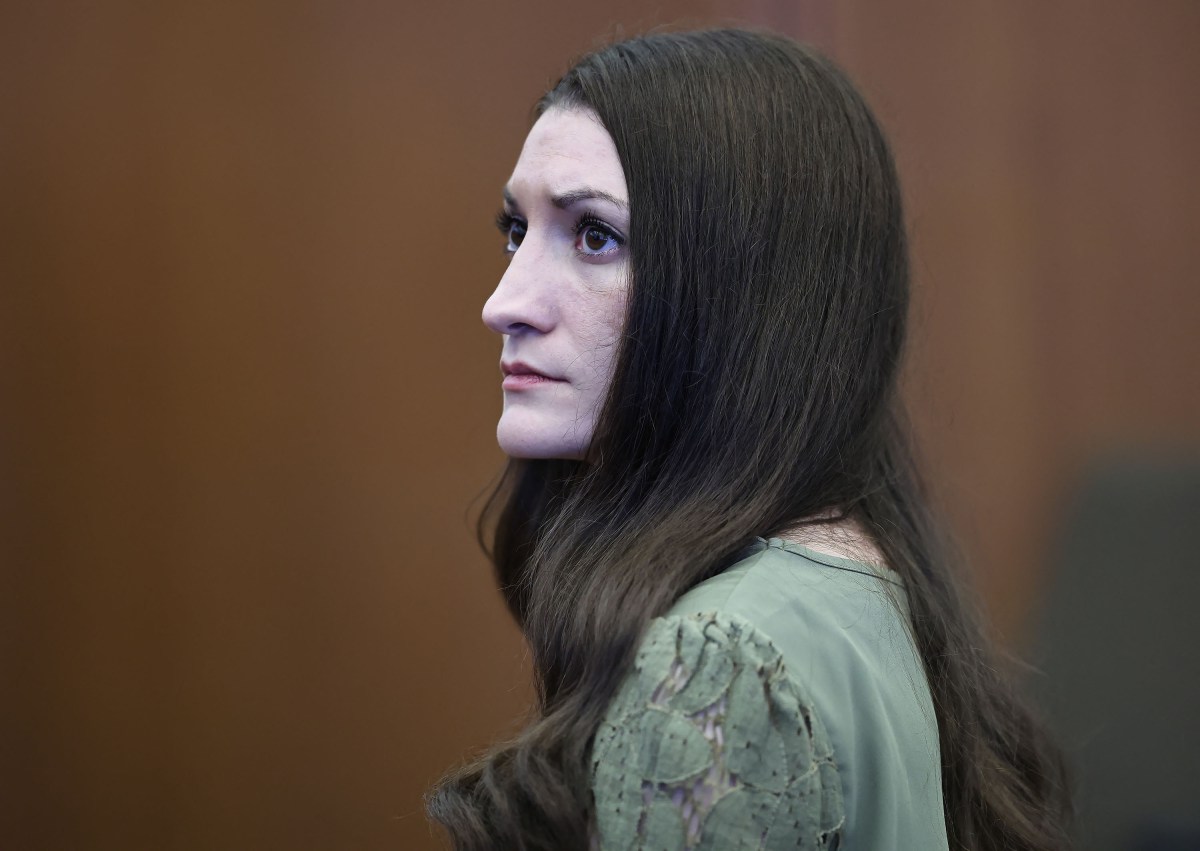
Legislation will be proposed to make it harder to plead not guilty by reason of insanity in a federal case, after Lindsay Clancy’s closely watched Massachusetts murder trial ended in a mistrial, a Georgia lawmaker said. Republican Representative Clay Fuller said the proposed legislation would restrict the use of the insanity defense in federal criminal cases, arguing that mental illness should not allow defendants to avoid accountability. Clancy, 36, was charged with three counts of first-degree murder in the deaths of her children, Cora, 5; Dawson, 3; and Callan, 8 months, in January 2023.
She had pleaded not guilty, and her attorneys argued that she was suffering from severe postpartum psychosis at the time of the strangulation deaths and her attempted suicide. Clancy “tried to tell a jury that they should let her walk free,” Fuller said. Newsweek contacted Fuller’s office for comment via email on Wednesday.
Four states—Idaho, Kansas, Montana and Utah—do not recognize a traditional insanity defense, according to FindLaw.com. Kay Levine, professor of law at Emory University, told Newsweek that “plenty of scholars have asserted that an insanity defense is a due process right. "Most insanity defense claims never succeed, because it is a very hard defense to prove.” According to the state, Massachusetts uses the term “lack of criminal responsibility.” A defendant may qualify if, because of a mental disease or defect, they lacked substantial capacity either to appreciate the wrongfulness of their conduct or to conform their conduct to the law.
The commonwealth must prove that the defendant was criminally responsible beyond a reasonable doubt. The federal standard is narrower. Under 18 U.S.C. § 17, defendants must prove by clear and convincing evidence that a severe mental disease or defect left them unable to appreciate the nature and quality or wrongfulness of their acts.
Because Clancy was prosecuted under Massachusetts state law, Fuller’s proposed federal legislation would not have applied to her case. While the jury did not reveal its vote in open court, notes referenced during the trial indicated that the panel was split 11-1 in favor of acquittal when the mistrial was declared. Clancy was facing the possibility of a life sentence had she been convicted of murder.
If she had instead been found not guilty by reason of insanity, the court would have had the option of ordering her commitment to a psychiatric treatment facility. With the trial concluding without a verdict, prosecutors are left to decide whether to retry Clancy, who previously worked as a labor and delivery nurse, drop the case or seek a negotiated resolution. Judge William Sullivan scheduled a hearing for September 29, when Clancy's defense attorney, Kevin Reddington, said he intends to seek dismissal of the case on double-jeopardy grounds.
Extract — continue reading at the source.