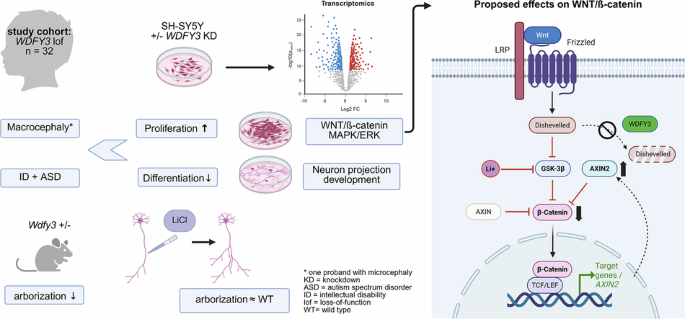
We provide a comprehensive phenotypic characterization of loss-of-function (LoF) variants in WDFY3 based on the largest cohort reported to date (n = 32). Our findings define a monogenic disorder marked by neuropsychiatric features (including autism and ADHD), mild to moderate neurodevelopmental delay, and variable brain growth – most commonly macrocephaly and in one case reduced head circumference. To investigate the effect of WDFY3 LoF we performed knockdown (KD) in the human neuroblastoma cell line SH-SY5Y and used a Wdfy3-haploinsufficient mouse model.
WDFY3 KD impaired clearance of protein aggregates and decreased protein levels of the ubiquitin-binding protein p62. Transcriptomic analyses identified dysregulation in gene networks that are primarily involved in nervous system development, neuron projection, MAPK/ERK1/2, and WNT/β-catenin signaling. This was confirmed at protein level.
Neuronal cell proliferation was increased, as evidenced by elevated cell counts and proliferation markers Ki-67 and PCNA. Conversely, neuronal cell differentiation was impaired, as indicated by reduced neurite outgrowth. We show that β-catenin is downregulated, while GSK3B is upregulated.
LiCl activates WNT/β-catenin signaling by inhibiting GSK3B. We thus tested LiCl treatment, which significantly increased WDFY3 expression. Moreover, in vitro treatment improved the neurite branching capacity of Wdfy3-haploinsufficient neurons above the level of the wild type, although this specific effect appeared independent of WNT/β-catenin signaling.
In sum, we expand on the phenotype related to WDFY3 LoF and provide insights into the pathophysiology using in vitro human and murine neuronal models. Our findings suggest that LiCl may serve as a potential therapeutic strategy for patients with WDFY3 LoF variants. WD repeat and FYVE domain-containing protein 3 (WDFY3) encodes an autophagosome scaffold protein involved in the selective recruitment and degradation of macromolecular cellular components, such as aggregated proteins [1].
WDFY3 is part of the beige and CHS (BEACH) domain-containing protein family and includes a BEACH domain, a pleckstrin homology (PH) domain, five WD40 domains, and a C-terminal Fab1/YOTB/Vac1/EEA1 (FYVE) domain that facilitates integration into vesicular membranes [2]. It is involved in key cellular processes including autophagy and endocytosis, is evolutionarily conserved from invertebrates, and is uwidely expressed [3], suggesting its functional relevance in maintaining normal cellular and organismal functions. In our previous work, we described 13 probands, mostly with de novo WDFY3 variants, who presented with intellectual and/or developmental deficits.
Extract — continue reading at the source.