Such imitative behavior is often assumed to be a universal phenomenon. However, most prior research has focused on Western, Educated, Industrialized, Rich, and Democratic (WEIRD) populations, leaving open whether people across different cultures imitate others in a similar manner. Ideomotor theory and the theory of objective self-awareness suggest that imitation is influenced by the extent to which individuals focus on the self versus others.
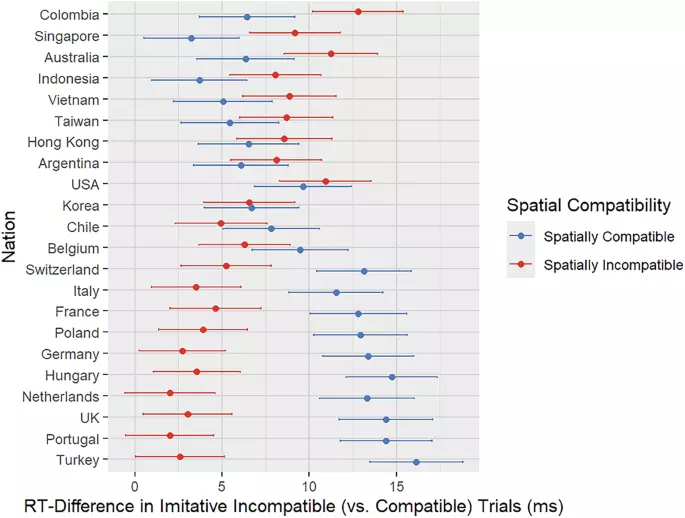
Since cultural background strongly shapes self-construal—particularly along the collectivism-individualism dimension—cultural context may play a key role in shaping imitative behavior. To test this prediction, we examined automatic imitation in representative samples across 22 culturally diverse nations varying in collectivism and individualism. Consistent with prior findings, we replicated the basic automatic imitation effect across all countries but found no compelling evidence for cultural differences in automatic imitation.
These findings hint to the possibility that automatic imitation is a universal phenomenon with little room for strong modulations by culture. People tend to automatically imitate each other1,2. Research has shown that such imitative behavior serves an important social function, as it bonds humans together by creating feelings of affiliation and mutual understanding3,4.
For example, imitation facilitates social interactions5 and increases liking for each other5,6,7—to name just a few examples. It is often assumed that automatic imitation is a universal phenomenon1,2. However, since research on imitative behavior has mainly been conducted in Western, Educated, Industrialized, Rich, and Democratic (WEIRD)8 societies, an open question is how universal the phenomenon of imitation actually is and whether people from different cultures vary in how they imitate others.
In particular, the question arises whether there are cultural differences in the underlying processes of automatic imitation. To shed light onto this question and further the understanding of the underlying mechanisms of imitative behavior, we investigated automatic imitation in representative samples in terms of age and gender across 22 different nations varying in the cultural dimension of collectivism/individualism. A classic task for measuring imitative behavior is the imitation-inhibition task9,10,11.
In this stimulus-response (S-R) compatibility task, participants respond to an imperative cue (e.g., number “1” or “2”) presented on the computer screen by lifting either the index or the middle finger. At the same time, they observe another person’s hand lifting either the same finger (congruent movement) or a different finger (incongruent movement). The logic of the task is that the instruction to engage in a different action than another person interferes with individuals’ automatic tendency to imitate, and as a consequence, slows down their response.
Extract — continue reading at the source.