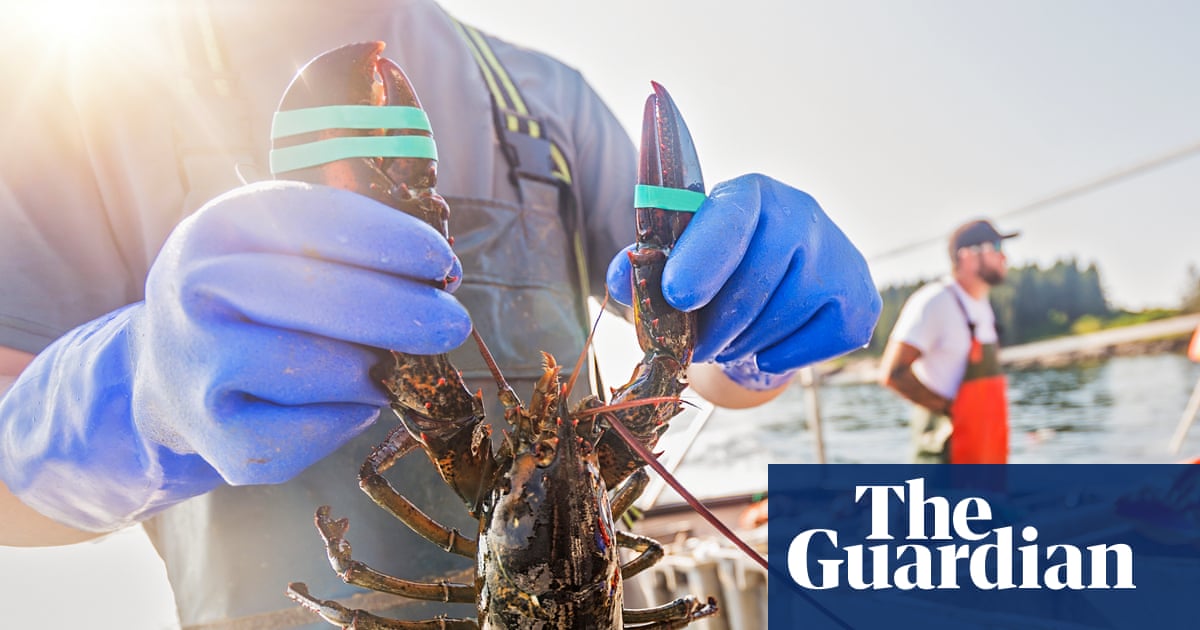
For many in the US region of New England, the lobster roll is synonymous with summertime. Loaded into a toasted bun, chunks of the sweet meat are served hot and soaked in butter, or chilled and slathered in mayonnaise with celery and herbs. The only thing more debated than the recipe is the price: the once-humble roll now routinely fetches $30 (£22), or even $50, in a sign of the changing times – and seas.
A third-generation lobster fisherman, Scott Lord spends his days hauling traps on the Gulf of Maine, which is warming faster than 99% of the world’s oceans. Bycatch that was once plentiful, such as sea urchins, sand dollars or starfish, are increasingly rare. And, most concerning, Lord has noticed the number of inshore lobsters dropping dramatically over the past 15 years, pushing fishers farther and farther offshore.
Motivated to find a remedy, Lord joined a regional shellfish committee. Why are they not coming back, no matter what we do?” he asks. Hundreds of miles to the south in Massachusetts, on a sandy crook of land that spins out to form Cape Cod, Adam Subhas, a scientist at the Woods Hole Oceanographic Institution, is trying to find the answers.
Subhas heads LOC-NESS (Locking Ocean Carbon in the North-east Shelf and Slope, an initiative researching how to decarbonise the ocean, also known as marine carbon dioxide removal (mCDR). Scientists working in this field are trying to discover whether the ocean, which is estimated to absorb about 31% of atmospheric carbon, could be manipulated to soak up even more. Proponents say ocean carbon removal could help stop the world from passing the 2C (3.6F) tipping point outlined in the 2016 Paris Agreement, if used in conjunction with the reduction of fossil fuels.
What was once a small-scale idea is rapidly gaining traction. A database newly launched by the Pulitzer Center, Ocean Carbon Removal Watch, which tracks mCDR investments, field trials and research, shows that more than £370m has been invested in the sector over the past five years. This was initially driven by the private sector but, thanks to a spate of US federal investments in 2023 – totalling at least £44m, according to a Guardian analysis of the database – scientific field trials began to catch up.
Until, that is, President Trump announced sweeping cuts to all federally funded ocean sciences. With federal science backing nearly dried up, LOC-NESS is the last “unicorn” for US ocean carbon removal. It is testing the technique that has garnered the most support in the past few years: ocean alkalinity enhancement (OAE).
Extract — continue reading at the source.