Understanding adolescent depression risk is vital for mitigating its long-term adverse effects. Though polygenic risk scores (PRS) explain increasing proportions of heritable risk, environmental risk remains challenging to quantify, hindering prediction. Existing prediction models often examine environmental risk in isolation, and vary in the number of predictors examined (between 8–800 + ), limiting generalisability.
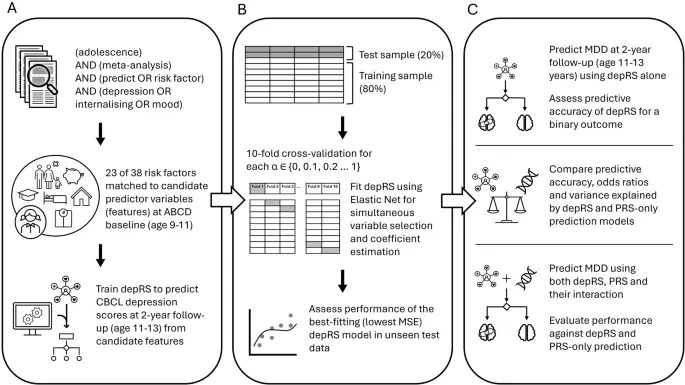
Here, we develop a model predicting adolescent depression symptoms (depRS) from a review of key environmental risk factors and assess depRS and PRS prediction of major depressive disorder (MDD) at 2-year follow-up. Using data from the Adolescent Brain Cognitive Development study (N = 9 797; 47% female), we generated PRS in European, African, American Admixed and East Asian ancestries from a recent trans-ancestry genome-wide study of MDD. We trained depRS to predict parent-reported depression symptoms at 2-year follow-up (age 11–13) from baseline predictors (age 9–11), using Elastic Net regression with 10-fold cross-validation for variable selection.
The final depRS model included 12 predictors and explained 12.3% of overall variance. Parental depression, witnessing domestic violence, sleep duration and dieting emerged as top predictors of depression symptoms. depRS showed better-than-chance classification of parent- (AUC = 0.69 [0.66–0.73]) and youth self-reported MDD (AUC = 0.67 [0.64–0.71]), outperforming PRS classification of parent-reported MDD (AUC = 0.64 [0.60–0.68]). Combining depRS and PRS maximised accuracy for both outcomes (Parent AUC = 0.71 [0.68–0.75]; Youth AUC = 0.70 [0.66–0.73]).
Though external validation of depRS across geographically and gender diverse cohorts is needed to assess generalisability, findings highlight sleep and dieting as potential targets for mitigating risk and demonstrate the utility of genetic scores in models predicting adolescent depression. Adolescence is a key developmental period characterized by continued brain and bodily development alongside significant life transitions and growing independence. The incidence of depression also rises during adolescence; 47% of people with depressive disorders begin experiencing symptoms by age 25 [1, 2].
Depression during adolescence is associated with poorer health, educational attainment and life satisfaction in adulthood, particularly with younger age of onset [3,4,5]. Such research highlights the need for prevention and early intervention in at-risk youth, and the need for effective methods of quantifying depression risk. Depression, like other mental health disorders, is highly heritable and polygenic, with many hundreds of genetic variations contributing small amounts to overall risk [6,7,8].
However, genetic risk alone is likely to always be insufficient for accurate prediction given the complexity and heterogenous nature of depression [7, 9]; current polygenic risk scores (PRS) representing cumulative genetic risk explain ~6% of variance in adult depression [8]. Additional sources of variance are environmental factors – the individual, family, peer, community and population-level influences on a young person’s life – and gene-environment interaction effects [5]. Incorporating these alongside PRS could improve prediction and future risk stratification of depression [5, 7].
Extract — continue reading at the source.