Few people have enchanted the popular imagination with science more powerfully and lastingly than physicist Richard Feynman (May 11, 1918–February 15, 1988) — the “Great Explainer” with the uncommon gift for bridging the essence of science with the most human and humane dimensions of life. Several months after Feynman’s death, while working on what would become Genius: The Life and Science of Richard Feynman (public library) — the masterly biography plumbing the wellspring of Feynman’s genius — James Gleick discovered something of arresting strangeness and splendor. A generation after computing pioneer Alan Turing tussled with the binary code of body and spirit in the wake of loss, Feynman — a scientist perhaps uncommonly romantic yet resolutely rational and unsentimental in his reverence for the indomitable laws of physics that tend toward decay — penned a remarkable letter to a physical nonentity that was, for the future Nobel-winning physicist, the locus of an irrepressible metaphysical reality.
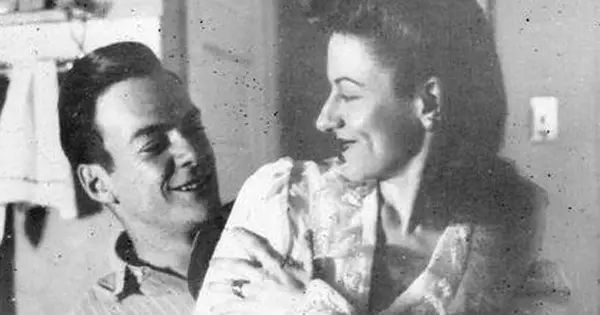
In high school, the teenage Richard spent summers at the beach in his native Far Rockaway. There, he grew besotted with a striking girl named Arline — a girl he knew he would marry. Both complement and counterpoint to his own nature, Arline met Richard’s inclination for science with ardor for philosophy and art. (The art class he took just to be near her would lay the foundation for his little-known, lifelong passion for drawing.) By his junior year, Richard proposed.
With the eyes of young love, they peered into a shared future of infinite possibility for bliss. But they were abruptly grounded when a mysterious malady began afflicting Arline with inexplicable symptoms — a lump would appear and disappear on her neck, fevers would roil over her with no apparent cause. Eventually, she was hospitalized for what was believed to be typhoid.
Feynman began to glimpse the special powerlessness that medical uncertainty can inflict on a scientific person. He had come to believe that the scientific way of thinking brought a measure of calmness and control in difficult situations — but not now. Just as Feynman began bombarding the doctors with questions that steered them toward a closer approximation of the scientific method, Arline began to recover just as mysteriously and unpredictably as she had fallen ill.
But the respite was only temporary. The symptoms returned, still shorn of a concrete explanation but now unambiguously pointing toward the terminal — a prognosis Arline’s doctors kept from her. Richard refused to go along with the deception — he and Arline had promised each other to face life with unremitting truthfulness — but he was forced to calibrate his commitment to circumstance.
His parents, Arline’s parents, and the doctors all urged him not to be so cruel as to tell a young woman she was dying. His sister, Joan, sobbing, told him he was stubborn and heartless. He broke down and bowed to tradition.
Extract — continue reading at the source.