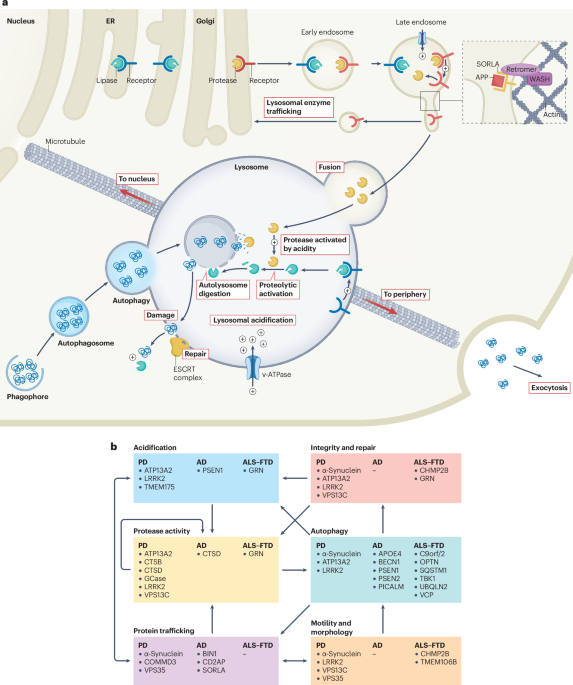
Examination of genetic risk factors associated with neurodegenerative diseases has provided important mechanistic insights into the pathophysiology of these disorders, and it has implicated defects in lysosomal function as a key component of the neurodegenerative process. The lysosome has a primary role in mediating degradation of both intracellular contents and endocytosed material from the extracellular space. Aggregation of misfolded proteins is a pathological mechanism that is observed across neurodegenerative disorders, and aberrant lysosomal degradation of such proteins plays a pivotal part in driving neuronal dysfunction and cell loss.
In addition to the crucial role of the endolysosomal system in degradation of intracellular constituents, lysosomes also serve as important nodes for intracellular signalling, participating in nutrient sensing, lipid metabolism, membrane repair and neuroinflammation. In this Review, we provide an overview of mechanisms of lysosomal dysfunction in neurodegenerative disease, with a particular focus on Parkinson disease, Alzheimer disease, frontotemporal dementia and amyotrophic lateral sclerosis. Identification of genetic causes of neurodegenerative disorders has revealed a major role for endolysosomal dysfunction in neurodegeneration.
Diverse aspects of endolysosomal function are impaired in neurodegenerative conditions including lysosomal acidification, lysosomal protease activity, endolysosomal trafficking, lysosomal motility, lysosomal membrane integrity and repair, and autophagy. The evidence for lysosomal dysfunction in neurodegeneration is most robust for Parkinson disease (PD), with a substantial proportion of PD-associated genes encoding proteins that are important for lysosomal function. These include the two most common genetic aetiological factors for PD, GBA1 and LRRK2, both of which are being targeted in clinical trials.
Endolysosomal trafficking defects have been implicated in Alzheimer disease (AD) pathogenesis. For example, deficiency of SORLA, which might represent a key regulator of cargo trafficking through the endolysosomal system, including trafficking of amyloid precursor protein, has been reported in AD. Multiple genes associated with amyotrophic lateral sclerosis and frontotemporal dementia (FTD) encode proteins with key roles in the regulation of autophagy.
Progranulin contributes to lysosomal homeostasis through multiple mechanisms, and progranulin augmentation strategies are being studied in clinical trials for FTD. This is a preview of subscription content, access via your institution Access Nature and 54 other Nature Portfolio journals Get Nature+, our best-value online-access subscription Receive 12 print issues and online access Prices may be subject to local taxes which are calculated during checkout Nixon, R. Mechanisms of autophagy-lysosome dysfunction in neurodegenerative diseases.
Cell Biol. 25, 926–946 https://doi.org/10.1038/s41580-024-00757-5 (2024). Udayar, V., Chen, Y., Sidransky, E. & Jagasia, R. Lysosomal dysfunction in neurodegeneration: emerging concepts and methods.
Extract — continue reading at the source.


