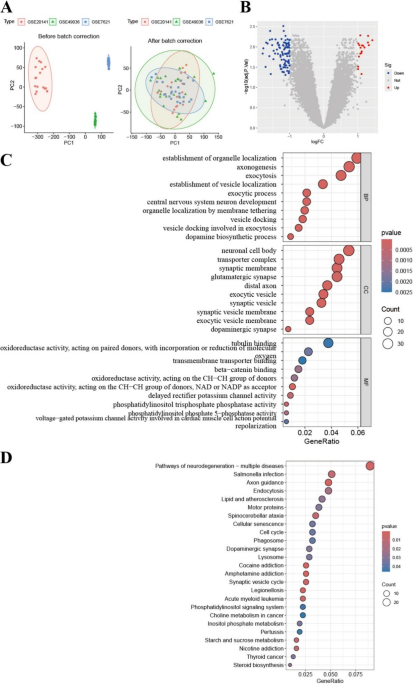
Despite significant scientific progress in recent years, a notable gap remains in the availability of reliable non-invasive biomarkers for the early diagnosis of Parkinson’s disease (PD). This study aimed to identify and validate novel plasma biomarkers for PD using integrated bioinformatics and machine learning. Transcriptome data from three Gene Expression Omnibus (GEO) datasets (GSE7621, GSE20141, GSE49036) were analyzed to identify differentially expressed genes.
Candidate biomarkers were screened using Least Absolute Shrinkage and Selection Operator (LASSO), Support Vector Machine-Recursive Feature Elimination (SVM-RFE), and Random Forest algorithms. For clinical validation, plasma levels of the selected candidates were measured via enzyme-linked immunosorbent assay (ELISA) in an independent cohort comprising 35 patients with PD and 32 healthy controls. A total of 116 differentially expressed genes were identified.
STX12 and INPP5D were selected as core candidates. Both were significantly elevated in PD plasma. Receiver operating characteristic (ROC) curve analysis revealed that STX12 yielded an area under the curve (AUC) of 0.788 (sensitivity 96.7%, specificity 53.1%), while INPP5D demonstrated an AUC of 0.674 (sensitivity 40.0%, specificity 93.8%).
The combined model yielded an AUC of 0.790. Both biomarkers correlated positively with platelet count but not with UPDRS-III score or disease duration. Overall, the above study findings indicate that STX12 and INPP5D are elevated in PD plasma, demonstrating distinct diagnostic potential.
STX12 exhibited high sensitivity, suggesting its potential as a screening tool, whereas INPP5D displays high specificity, indicating value in confirmatory diagnosis. However, the combined model offered limited diagnostic improvement over STX12 alone, and neither biomarker correlated with disease severity. These preliminary findings require validation in larger, independent cohorts before clinical translation.
Parkinson’s disease (PD) is the second most prevalent neurodegenerative disorder, currently affecting over 6 million patients worldwide1. Its pathological hallmark is the abnormal aggregation of α-synuclein in dopaminergic neurons of the substantia nigra compacta, culminating in the formation of Lewy bodies, progressive neuronal loss, and impaired dopamine synthesis. Clinically, PD is characterized by motor symptoms including resting tremor, rigidity, bradykinesia, and postural instability2,3.
Extract — continue reading at the source.