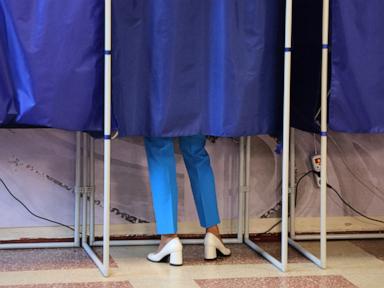
Election officials say the Kremlin's main party has retained its majority in Russia’s parliament The main Kremlin party retained its majority in Russia’s parliament, election officials said Monday, after a carefully orchestrated balloting that excluded most opposition candidates and helped the government maintain its tight grip on power. Results from over 95% of the polling stations gave the Kremlin’s United Russia party just under 58% of the vote for the 225 seats apportioned by parties, according to the Central Election Commission. Another 225 lawmakers were chosen in single-ballot races, and the results showed United Russia candidates leading in 208 of those races.
Central Election Commission chair Ella Pamfilova said the preliminary results indicated that United Russia would get 355 seats out of 450. It was the first parliamentary election held since President Vladimir Putin launched the full-scale invasion of Ukraine in 2022, and the first to include residents of four regions of that country that were seized and illegally annexed by Moscow later that year. Voting also was held in Crimea, which was illegally annexed by Russia in 2014.
Kyiv denounced the voting in those regions as illegal. The Kremlin tightened its crackdown on opposition ahead of the election, including barring Russia’s only liberal, anti-war party from the ballot and allowing it to compete only in single-ballot races. Along with United Russia, several other parties that almost always vote for Kremlin initiatives also won seats in the State Duma, the lower house of parliament.
The Kremlin has sought the parliamentary election to showcase popular support for the war, and strove to avoid political risks by stamping out any dissent. A massive state media campaign and tight control over the election in the absence of genuine opposition left little doubt that Kremlin will keep tight control of Russian politics as economic costs rise and Ukrainian drone attacks increase deep inside the country. Voters cast two separate ballots, filling half of the Duma’s 450 seats by selecting political parties listed on the ballot.
The rest were contested in single-seat constituencies, with voters choosing individual candidates. The liberal Yabloko party, the only registered political entity that dared to publicly criticize the war, was removed from the ballot last month by Russia’s Supreme Court, and only has a few dozen candidates in the single-constituency races. Additionally, some anti-war politicians were imprisoned or forced to flee abroad ahead of the campaign.
Yabloko and the Communist Party, which has criticized some aspects of government policy but carefully avoided any criticism of Putin, said many of their observers were turned away from polling stations. Russia didn’t invite observers from the Organization for Security and Cooperation in Europe, with the Russian Foreign Ministry accusing the body of “double standards” for its criticism of Russia. OSCE Parliamentary Assembly President Pere Joan Pons said that the decision was a breach of Russia’s commitments as a member state of the organization.
Extract — continue reading at the source.