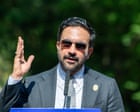
When the New York City mayor, Zohran Mamdani, announced the city’s first-ever municipal strategy to address antisemitism – a nuanced, multi-pronged approach ranging from greater security measures for synagogues to an increased focus on Jewish history in public school education – critics were quick to note what the 33-page document does not mention at all: Israel. Israel has played an outsized role in Mamdani’s campaign and since his election, with the mayor standing by his years-long support for Palestinians, and frequently describing Israel’s actions in Gaza as genocide and Prime Minister Benjamin Netanyahu as a war criminal. His positions have split New York’s Jewish communities, and earned him frequent accusations that he is fomenting the very antisemitism he has pledged to fight.
At the United Nations general assembly last week, Netanyahu – who is wanted for war crimes and crimes against humanity by the international criminal court (ICC) and whom Mamdani had at one point pledged to arrest – called him “the antisemitic mayor of New York”. Mamdani has gone to great lengths to engage with representatives of New York’s many Jewish communities and the antisemitism strategy, several of them said, reflects those conversations and the mayor’s willingness to listen to those communities’ concerns. Still, many of the critiques hinge on an absence: Mamdani’s strategy does not endorse a specific definition of antisemitism, the subject of many disputes largely stemming over the centrality of Israel to Jewishness.
Instead it mentions three different ones while noting that “New York City can and will leverage all of the tools at its disposal to combat antisemitism effectively without needing to adopt a definition for this specific form of hate”. Federal hate crimes statutes, the strategy notes, also do not adopt a standalone definition of discrimination. Instead, the strategy, which was announced on Tuesday, cites extensive polling capturing how Jewish Americans feel about safety and antisemitism and notes the diversity of ways in which they experience antisemitism.
The document adds that New York police have reported a “notable increase” of anti-Jewish crimes in the three years since the 7 October Hamas attacks in Israel and its subsequent war in Gaza, and references a string of antisemitic incidents across the country going back years, including the attack on the Tree of Life Synagogue in Pittsburgh, which killed 11 people in 2018. While Jews make up 12% of the city’s population, antisemitic crimes make up more than half of all hate crimes, the mayor said in a video introducing the strategy. The plan has reignited criticism of the mayor – from both pro-Israel and pro-Palestine camps.
A coalition of Jewish organizations and the New York board of rabbis wrote in a joint statement that the strategy “fails to address a central issue that the Mayor himself has perpetuated: rhetoric that demonizes and delegitimizes Israel inevitably leads to the targeting of Jewish New Yorkers”. Meanwhile, some of the left have also been unhappy with the plan. But at root this is a municipal hate crimes prevention strategy.
Nobody benefits by obsessively reading it through the [Israel/Palestine] prism.” Those who praised the plan saw the omission of Israel as a welcome and deliberate effort to separate what has so often been conflated: antisemitism and criticism of Israel, which can veer into antisemitism but is not that by default. Mamdani’s plan “makes it really clear that Israel is not a synonym for Jew”, Lila Corwin Berman, director of the center for American Jewish history at New York University, said. The report analyzed how anti-discrimination protections enshrined in the Civil Rights Act apply to campus antisemitism and drew a distinction – collapsed by both the Trump administration and many universities – between conduct “motivated by hostility toward people of Jewish ancestry as such” and speech criticizing “ideas or institutions” such as Israel or Zionism.
Extract — continue reading at the source.