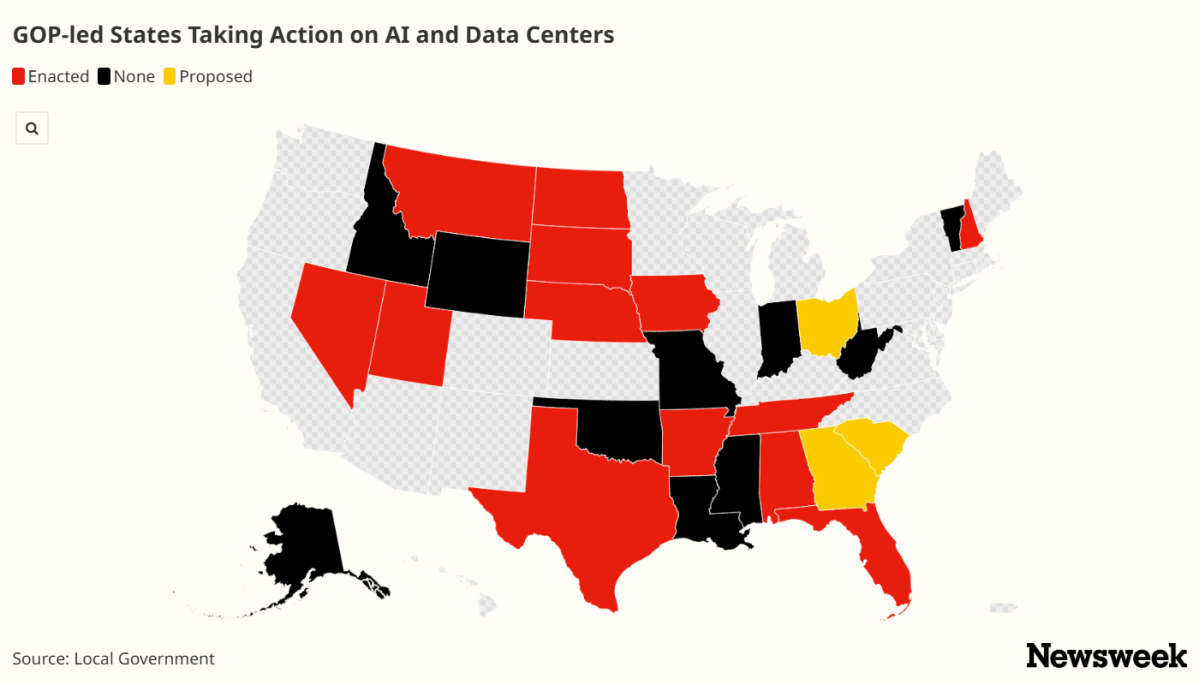
As President Donald Trump pushes to accelerate America's artificial intelligence boom, governors across the country—including Republicans—are imposing new conditions on the data centers needed to power it. The divide is becoming increasingly visible as the November midterm elections approach. Data centers have moved from being largely an economic-development issue to a political one, with residents in communities across the country raising concerns about electricity prices, water use, land, tax breaks and the cost of building infrastructure for massive new facilities.
The result is an unusual tension inside the Republican Party. Trump has made rapid AI development a national priority, arguing that the United States must move quickly to maintain its technological advantage over China. But Republican governors in states including Texas, Florida, Nevada and Nebraska have imposed, or moved toward imposing, conditions on data-center development.
Nevada became the latest example on Friday. Republican Governor Joe Lombardo announced tighter conditions for data centers seeking state tax abatements, including requirements concerning taxes, energy costs and the impact of projects on water, infrastructure and communities. Lombardo's administration continues to present data centers as an economic opportunity.
But the new rules reflect a growing effort among state officials to ensure that residents are not left paying the costs of the AI boom. A September New York Times/Siena poll found that 61 percent of likely voters opposed the construction of data centers to support AI, compared with 34 percent who supported it. Opposition reached 75 percent among Democrats and 47 percent among Republicans, while independents opposed construction by 60 percent to 36 percent.
A separate University of Massachusetts Amherst poll found that 65 percent of Americans opposed building an AI data center in their own community. Even Republicans opposed local construction by 52 percent to 18 percent. The concerns are often less about artificial intelligence itself than about what the infrastructure required to run it means locally.
Data centers can consume enormous quantities of electricity. Depending on their design and location, they can also require substantial water resources. Communities are questioning whether utilities, taxpayers and existing ratepayers should bear the cost of connecting facilities to the grid or expanding infrastructure to serve them.
Extract — continue reading at the source.