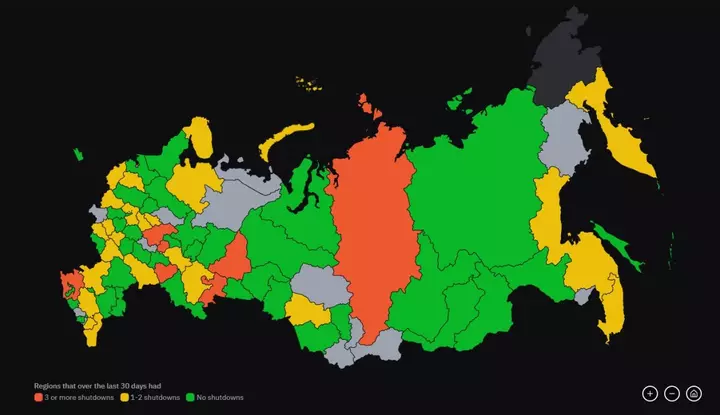
An interactive map tracking Russia’s internet disruptions has recorded 80 incidents across 36 regions in just over a month, as a VPN provider warns of increasingly coordinated shutdowns and more sophisticated attempts to block access. Amnezia Pulse recorded the incidents between September 15 and October 20, 2026. Krasnodar Krai was the worst-affected region, with nine incidents, followed by Samara Oblast and Nizhny Novgorod Oblast, with six each.
Including data collected in April and May, before Amnezia was forced to pause the project following what it described as an attack by Russia’s internet regulator, Roskomnadzor, the project has recorded disruptions in at least 45 regions—more than half of Russia. Amnezia says it has also recently observed a new pattern of synchronized internet shutdowns affecting multiple Russian regions and telecommunications operators at the same time. For some residents, the restrictions have become so severe they are resorting to unusual workarounds just to stay in touch with family.
Amnezia highlighted overlapping incidents in Sverdlovsk and Chelyabinsk regions, which it says occurred twice, as well as a synchronized shutdown affecting three operators in St. Disruptions can last a few hours or continue for two or three days, and sometimes, speeds fall so sharply that videos and audio will not load, leaving only basic text browsing practical. The organization expects restrictions to spread further to fixed-line internet providers, although it cannot predict when or how extensively that will happen.
For Alex, the difference between Moscow and other parts of Russia is stark. Most often, the disruptions happen in cities with a population of under 500,000. In cities with over a million people, the cellular service and internet are more or less fine.
However, in places like Murom, the Kuzbass region, and Kaspiysk, the internet operates strictly on 'whitelists' (only pre-approved sites work),” he said. Even services that are supposed to remain available can become inaccessible, Alex says. He describes disruptions that prevented people from ordering groceries, calling taxis or using navigation.
For example, the recent attack on Yandex data centers hit us very hard. You couldn't order groceries, call a taxi, or use the GPS navigator, and alternative services simply aren't on the whitelists,” Alex said. In some areas, Alex says restrictions are so severe that he has started carrying alternative communications equipment.
Extract — continue reading at the source.