President Donald Trump has threatened “serious” new tariffs on the European Union (EU) over its plans for increased economic and political integration with Canada, putting at risk the billions of dollars’ worth of commerce U.S. states enjoy with the trading bloc. On Wednesday, European Commission President Ursula von der Leyen said the 27-member organization was prepared to welcome Canada as its first “associate member”—an unprecedented status involving closer ties on trade, security and other matters that Trump called “laughable.” “I think it’s laughable, the whole thing with Canada,” Trump told reporters on Wednesday after arriving in North Carolina ahead of a rally in Gaston County. If they do that—if I think it’s at all a hostile act—I will put very serious tariffs or stop trading with Europe on many things.” In response, the European Commission’s trade spokesperson, Olof Gill, told Newsweek that the “proposed strengthening of our partnership with Canada is not against anyone else, but for our common strength.” Newsweek has contacted the U.S.
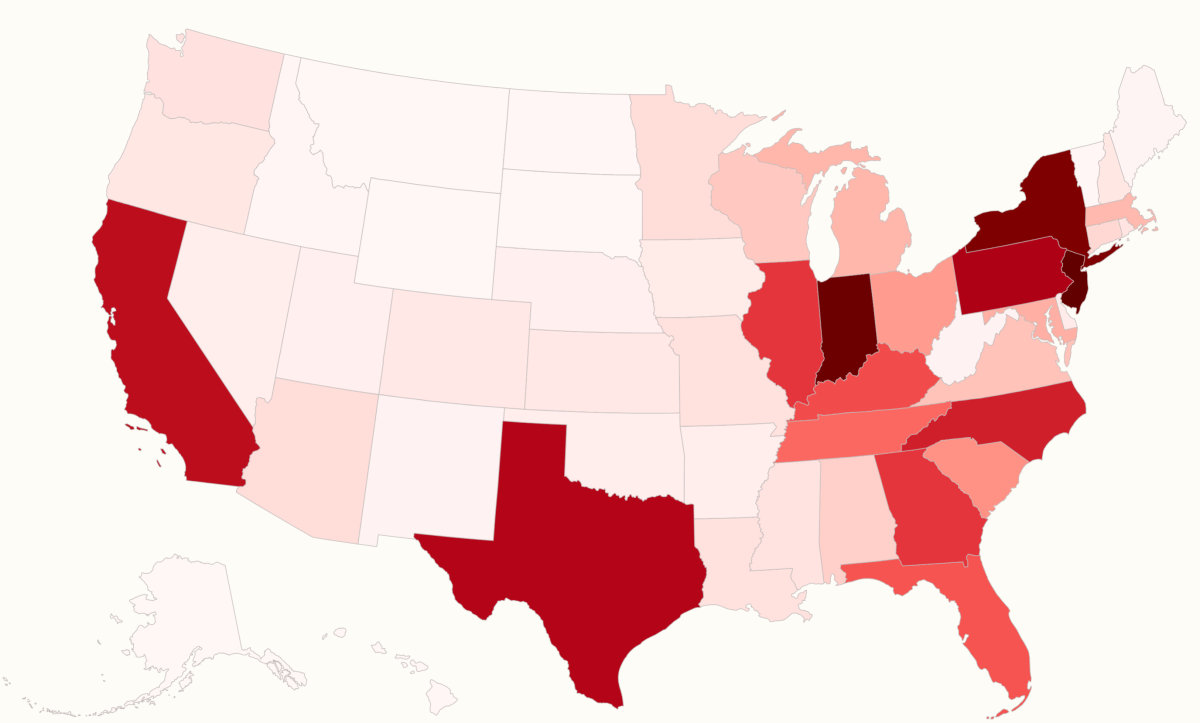
Department of Commerce and the U.S. Trade Representative for further information and comment on Trump’s remarks outside regular working hours. The impact of a major reduction in bilateral trade with the EU on individual states can be inferred using 2024 figures from the U.S.
Those arranged by the data-visualization website Visual Capitalist show that, in terms of overall imports, New Jersey is the most reliant on European trade, with more than $60 billion worth of EU goods reaching the state in 2024. Aside from Texas and California, the data reveals that states in the eastern portion of the country take in the most EU imports, with New Jersey followed by Indiana and New York at $58.7 billion and $56.3 billion, respectively. In terms of the share of their imports that the EU accounts for, Indiana was the most reliant at 46 percent, followed by South Carolina at 45 percent and Rhode Island at 39 percent.
And the prospect of further duties could compound the challenges of states already facing a reduction in bilateral trade with Canada—still the second-largest U.S. trading partner—after Trump placed 50 percent tariffs on roughly $28 billion worth of Canadian goods, and Prime Minister Carney responded “dollar for dollar.” In his speech before the European Parliament in Strasbourg, France, on Wednesday, Carney outlined his vision for a “deeper partnership” between Europe and Canada, and he said this would help form a “protective canopy under which our citizens can thrive.” “This is about sovereignty, our ability to live as we wish,” he said. On the EU side, economist and London School of Economics and Political Science professor Aurélien Saussay said that the bloc's automobile sector would be hit hardest. "The pain would be concentrated geographically, with Germany and central Europe being worst affected," he told Newsweek.
"Pharmaceuticals are the biggest category at 29 percent of European exports to the U.S., but a tariff there lands mostly on American drug prices." Trump did not specify the “many things” on which the U.S. could curb its trade with Europe, but the bloc remains among its most critical partners across a number of sectors. According to the European Commission, total goods trade between the pair reached €910.6 billion ($1.04 trillion) last year, with the U.S. importing €554.9 billion while exporting €355.7 billion—valued at $636.8 billion and $408.2 billion in current U.S. dollars. Trade Representative’s Office puts the combined figure for goods and services at around $1.6 trillion—an 8 percent increase—with a deficit of $220.3 billion for goods but a $107.3 billion shortfall when it came to trade in services.
In terms of the most significant items, European Commission data shows that the U.S. imported €160.6 billion ($184.3 billion) worth of medicinal and pharmaceutical products from the EU in 2025. At 29 percent of its overall shipments, that makes it the bloc’s most significant American export, followed by road vehicles, industrial machinery, electrical equipment and parts, and power-generating machinery. Medicinal and pharmaceutical products also represented the bloc’s top import in 2025—accounting for 17 percent—followed by petroleum products, power-generating equipment, natural gas and transport equipment.
Extract — continue reading at the source.