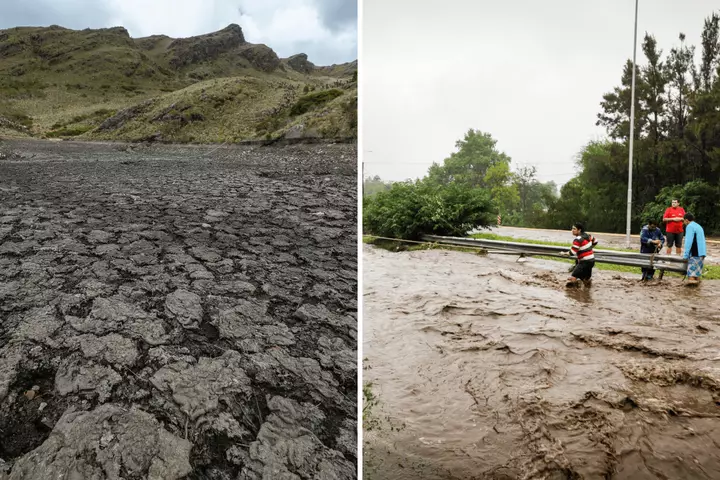
Governments across the Americas have declared emergencies or activated their highest-level alerts as the 2026-2027 El Niño threatens communities with drought, flooding, extreme rainfall, and water shortages. Bolivia became one of the latest countries to act, declaring a national emergency on October 31 because of drought and the imminent threat of other extreme weather conditions associated with El Niño. It follows emergency measures implemented elsewhere in Central and South America, including Panama, Colombia, Peru, Ecuador and El Salvador.
States and provinces in the United States, Brazil and Argentina have also introduced emergency response actions. Some have issued formal states of emergency, while others have declared national disaster situations, or issued red alerts. Bolivia declared a national emergency on Oct. 31 through Supreme Decree No. 5759 because of the existing drought and the imminent threat of adverse events associated with the 2026-2027 El Niño.
According to local press, the emergency was declared in response to drought in the Altiplano, Valleys and Chaco and the threat of further extreme weather, such as frost, hail, forest fires, flooding and overflowing rivers, all linked to El Niño. The measure allows central government institutions, as well as departmental and municipal governments, to activate their emergency coordination and intervention procedures. In the Decree, the government said the aim was to “protect the health and livelihoods of the Bolivian population in the face of drought and the imminent risk of adverse events associated with the 2026-2027 El Niño phenomenon.” While the decree doesn’t require people to evacuate or take any specific action, residents should follow official advice if conditions change.
Panama declared a national state of emergency on August 26 because of the potentially dangerous weather effects of El Niño. The declaration, made through Cabinet Resolution No. 102-26, remains in effect until June 30, 2027. Officials said at least 15,643 people had been affected by flooding since the beginning of 2026, with more than 70 percent of those affected in Bocas del Toro and Colón.
At the same time, forecasts pointed to “rainfall deficits during the months of October, November and December 2026, as well as in January, February and March 2027” that could produce drought, lower reservoir levels and problems for agriculture and hydroelectric generation. Authorities also warned that drought and low water levels could impact ship traffic and operations at the Panama Canal. Panama’s National Civil Protection System (SINAPROC) has urged residents to use drinking water responsibly, repair leaks, keep basic reserves of water and nonperishable food, avoid burning waste or vegetation, and remain hydrated.
Colombia declared a national disaster situation for an initial period of 12 months under Decree 0802 as of July 23 in anticipation of the effects of El Niño. The government said that reduced rainfall could threaten drinking-water supplies, hydroelectric power, and key public services, while increasing the risks of wildfires and deteriorating air and soil quality. When the announcement was made in July, 558 municipalities were considered at “high or very high risk of drinking water shortages,” with 111 facing the “most critical conditions.” President Gustavo Petro warned that the country “will have a megadrought affecting a large part of the national territory between December 2026 and March 2027.
Extract — continue reading at the source.