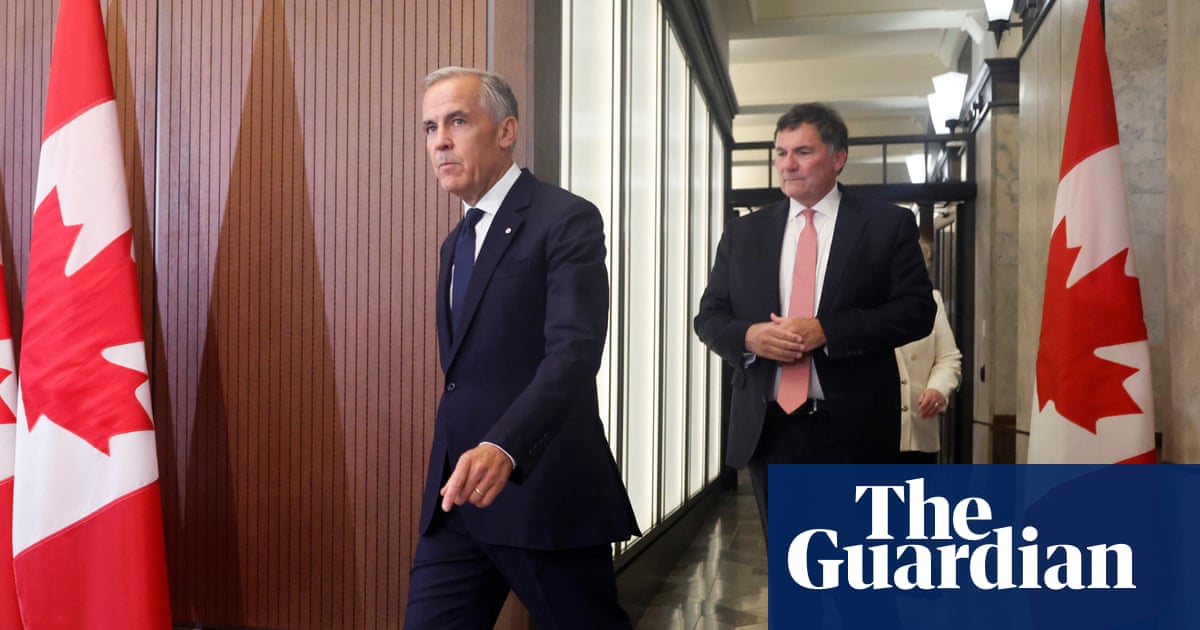
Mark Carney said on Monday that while American negotiators saw the French language in Canada as an “irritant … in Quebec, these are rights,” days after receiving widespread praise from political leaders for rejecting a US trade proposal that many perceived as weakening the country’s Francophone culture. The prime minister’s remarks came hours after the US president, Donald Trump, showed little interest in retreating from the spat, posting on social media that Canada had been “ripping off the United States of America for years” and threatening a swath of new, economically devastating tariffs on cars and trucks. Carney instructed his negotiators to walk away from trade talks last week.
Tariffs on an array of Canadian products took effect over the weekend, affecting around 5% of Canada’s exports to the US, and Canada said it will retaliate in early September. On Monday, Carney toured a shipyard with Quebec’s premier, telling attendees Canada “could not accept” a proposed trade deal that would have weakened French language protections after trade talks collapsed between the two countries last week, adding that his government “will not give what they have asked”. The prime minister’s decision to abandon trade talks with the US spurred declarations from political leaders and pundits in Canada that the country is now fully locked into an economic war with its longtime ally.
Quebec, Canada’s predominantly French-speaking province, has long sought to protect its distinct identity, at times with laws that clashed with the federal government and the Canadian charter of rights and freedoms. In recent years those rules have also frustrated US negotiators, who have framed them as trade irritants. Bill 96, for example, requires products sold in Quebec to have a French description and for trademarks using generic terms to be translated into French, while Bill 109 compels media services such as Netflix, Spotify and Apple to promote and prioritize French content for Quebec users.
Quebec’s premier, Christine Fréchette, said Carney had made the right decision in walking away from talks that looked to cross a “red line” for Francophones. We will stay the way we are.” Polling from earlier in the month shows that dislike for Trump is highest in Quebec. Separatists in the province have seen a sharp decline in support amid the economic wounds inflicted by the US.
Last week, Paul St-Pierre Plamondon, the sovereigntist politician most likely to emerge victorious in upcoming provincial elections, said his party would delay a possible referendum into seceding from Canada until Trump is out of office. He wrote that deciding Quebec’s political fate “must not be hijacked by the upheaval of American politics, the outbursts of an unpredictable president or by a campaign of fear”. The Quebec Federation of Chambers of Commerce (FCCQ) called the tariffs a “worst-case scenario” for the province’s businesses.
In fact, it has already begun.” On Monday, Trump’s top trade representative, Jamieson Greer, called reports that French language protections were up for debate a “a funny fake story”. He claimed the issue at stake was that Americans did not like Canada “forcing” streaming giants in the US to pay some of their profits to support Canadian content. Canada had already dropped that position, however, previously abandoning elements of digital services tax.
Extract — continue reading at the source.