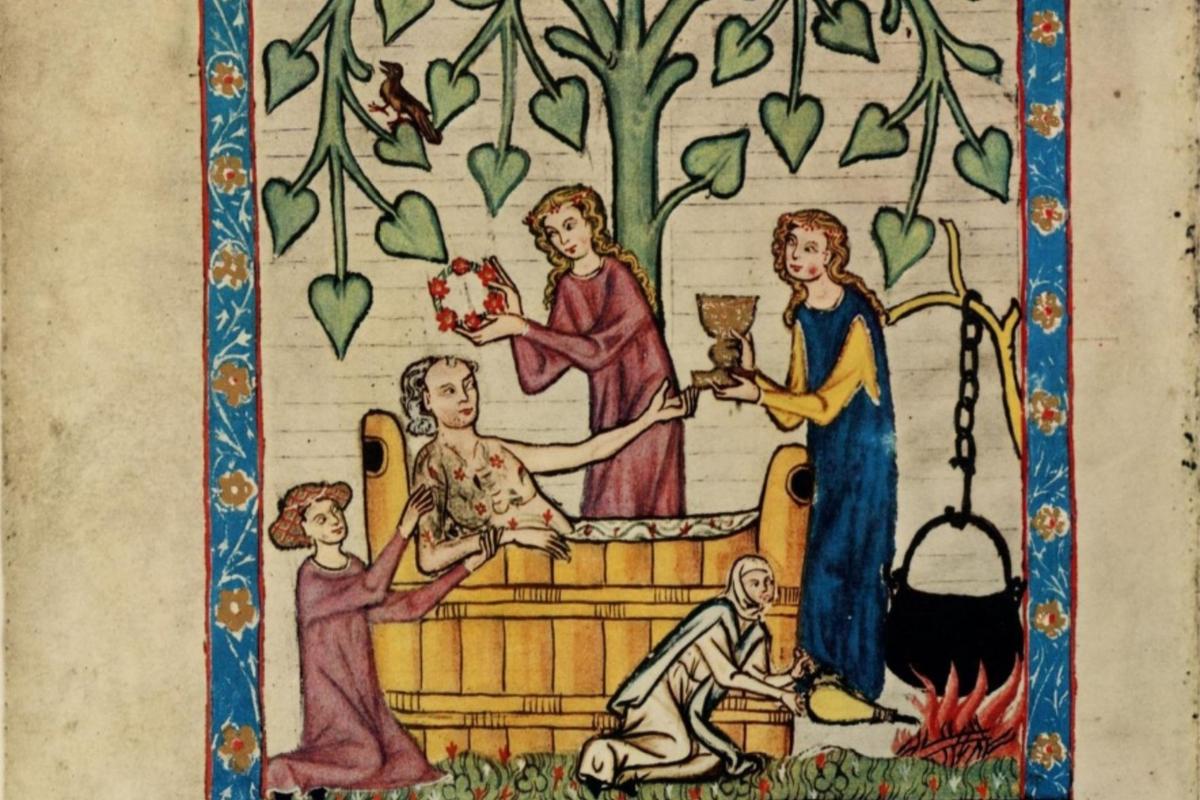
There, he was immediately surrounded by a crowd of people, who begged him to help one of their neighbours. And so, dismounting from his horse, he went to the man’s house, where he was confronted by the disturbing sight of a possessed man ‘lying prostrate with his head tied to a post and each of his hands to great stakes fixed in the ground.’ Despite these restraints, the man constantly writhed around, rolling his eyes, gnashing his teeth, and sticking his tongue out. To Hugh, as to the local onlookers, the diagnosis was clear: this unfortunate sailor had been possessed by a demon and could be cured only by an exorcism.
Once the necessary rituals were performed, he was ‘delivered from the demon [and] … after living devoutly for some years, finally made a good and peaceful end.’ For Hugh’s biographer, Adam of Eynsham, the incident was worth recounting because it demonstrated not only that the future saint had healing powers, but that he was a brave and compassionate man (in sharp contrast to the local bishop, who had ‘galloped away as if pursued by the Furies’, rather than face a possessed man). But, to us, the story – full of fear, cruelty and superstition – sums up both everything that was wrong with medieval attitudes to mental illness, and the apparent uselessness of medieval medicine in the face of serious illness. And yet, as is so often the case when studying the distant past, the reality was rather more complicated.
Influenced by stories of demonic possession (and there are lots of them, especially in saints’ lives and miracle collections), I long assumed that our ancestors’ attitudes to, and experiences of, mental health were completely different to our own – and that they would have little sympathy with our fast-growing mental health crisis. But when I turned my attention away from religious texts, and began to research medieval ideas about healthy living, I soon came across medieval people who discussed mental health in ways that felt far more familiar to me. The similarities were particularly apparent in medical writings, which outline a sophisticated argument that mental wellness was at the heart of a healthy lifestyle.
According to the dominant humoral system of medicine, health was achieved by keeping four bodily fluids (blood, phlegm, black bile, and yellow bile) in balance. The best way to do this was through careful management of the six non-naturals, a set of external factors that had a direct impact on the human body, and that included many of our modern preoccupations, such as diet, exercise and sleep, as well as the emotions. This last factor featured prominently in regimens (how-to books about healthy living, which were extremely popular in late-medieval Europe), in which people were warned that, for the sake of their health, they must control their emotions.
According to the 14th-century Sevillian physician Juan de Aviñón, ‘it is necessary that a man that wishes to preserve his health will not become angry, nor irritated, nor worried as much as possible, because once he does so he greatly harms his body.’ Similarly, the Bavarian physician Arnold von Bamberg warned that emotional dysregulation could disrupt an individual’s eating habits, exercise routine and ability to sleep; a person who did not pay sufficient attention to his feelings would inevitably end up needing medical treatment. And it seems that people did blame their bodily ailments on mental travails. For example, in 1395, when the Italian politician and wool merchant Niccolaio Martini was ill with a high fever, he told his friend Margherita Datini that ‘he came down with this illness after getting very upset’ about the result of a recent election.
Too much responsibility could make a person ill, with high-status men thought to be at particular risk Certain emotions were so detrimental to health that they could cause sudden illnesses, or even death. Fear was especially dangerous: among the miracles performed by the hand of St James (which was kept at Reading Abbey from the mid-12th century) was the cure of Alice, an Essex clerk’s daughter who saw a ghost when milking sheep on Good Friday. Her terror caused the blood to freeze around her heart, and so confused her senses that she suffered a temporary fit of mania and threw herself into a fire.
Extract — continue reading at the source.