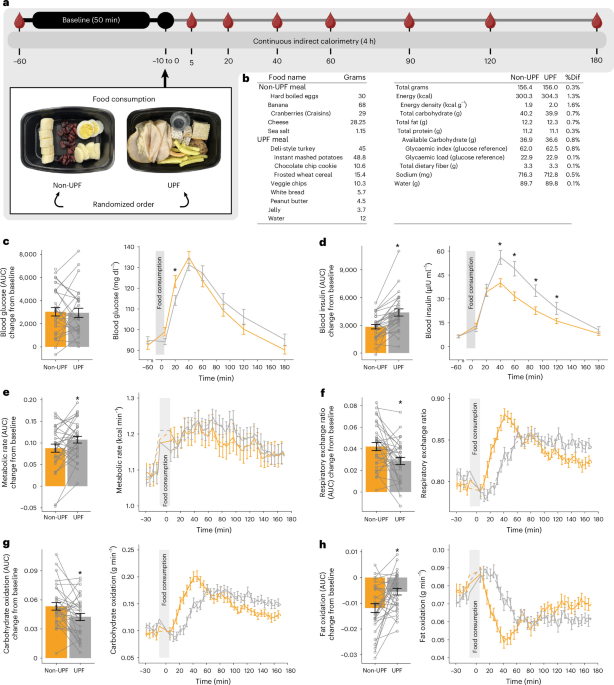
Dietary patterns worldwide have shifted toward increased consumption of ultraprocessed foods (UPFs), which has been linked to higher disease burden. One proposed mechanism underlying both UPF consumption and metabolic disease is altered post-ingestive responses relative to nutritionally similar foods. Here we report the effects of food processing on post-ingestive metabolism and brain response in a randomized, crossover study involving 57 healthy-weight adults who consumed a nutritionally matched UPF or non-UPF meal.
We show that despite being nutritionally similar, UPF meals evoke greater insulinaemic and energetic responses, with attenuated carbohydrate oxidation relative to non-UPF meals. Between-condition differences in peak carbohydrate oxidation are associated with striatal activation in response to food cues. We also find that although subjective food value does not differ between conditions, brain responses correlated with food valuation are positive for non-UPF but negative for UPF in the visual cortex and striatum.
Overall, these findings suggest that food processing influences post-ingestive metabolic and neural responses through mechanisms beyond calories and macronutrients alone. The modern food environment has undergone a shift towards widespread availability of UPFs1,2. Under the Nova classification system, UPFs are industrially manufactured products that undergo multiple physical and chemical transformations and typically contain added industrial ingredients, specifically additives not commonly used in home cooking3.
Concerningly, higher UPF intake is associated with poorer health outcomes, including cancer, overweight and obesity, and metabolic dysfunction4,5. Despite these adverse health associations, UPFs comprise the majority of calories consumed in the United States and most of the food market1,2. Although the mechanistic basis for UPF-associated health effects is not fully established, the incorporation of manufacturing processes that alter nutritional availability has been proposed as a potential factor5.
Even with the same ingredients, micronutrient bioavailability differs after food processing6. For macronutrients, industrial extrusion divides starches to produce a spectrum of fractions, granules and crystalline structures, augmenting digestibility and resulting in distinct glycaemic and insulinaemic properties7. For example, compared with steel-cut, instant oats that have been cooked at higher temperatures to partially gelatinize the starch elicit a higher glycaemic index despite still only containing oats8.
Varying the cellular microstructure of chickpeas, including disrupting cell walls as seen in many UPFs, produced larger postprandial glucose and insulin excursions and greater concentrations of glucose and maltose in the duodenum9. Although evidence that food processing could lead to altered metabolic function is accumulating, much of it comes from studies that did not explicitly test foods that differ on the Nova score while controlling for nutritional composition. If UPFs elicit augmented physiological responses owing to altered nutritional availability relative to nutritionally matched foods that are not ultraprocessed, not only could this provide a potential mechanism for their effects on metabolic health but also may represent a key mechanism contributing to their overconsumption.
Extract — continue reading at the source.


