Microplastics have been found throughout the human body, including the brain, lungs and blood. Past studies have identified associations between the tiny particles and various health issues, such as cardiovascular disease, dementia and reproductive problems. But the exact way they might contribute to these problems has been unclear.
Now, scientists say they’ve found an answer: Microplastics appear to generate highly reactive molecules when they interact with water. If the same effect were to happen in our bodies, microplastics could lead to oxidative stress, which damages cells, and inflammation. The findings, published in the journal Nature on October 14, challenge the idea that plastics don’t easily react with other substances and point to how they can cause harm to humans.
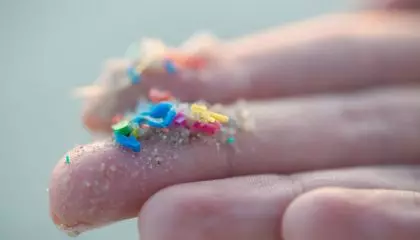
When plastics degrade into microplastics—pieces smaller than a pencil-tip eraser—their surface-to-volume ratio goes up. For example, if a credit card gets broken down into bits just ten microns in diameter, or around one-tenth the thickness of a sheet of paper, that increases its surface area more than 200 times, explains study co-author Wei Min, a chemist at Columbia University, to Payal Dhar at Scientific American. The more exposed area, the more chemical activity.
To better understand how these tiny fragments might generate chemical activity, Min and colleagues examined particles of widely used bulk plastics, including polyethylene, polypropylene, polystyrene, polyvinyl chloride and polyethylene terephthalate. Analyses revealed that when microplastics interact with water, they spontaneously generate unstable molecules known as reactive oxygen species. Because plastic repels water, or is hydrophobic, the surrounding water can’t form its usual hydrogen bonds.
So, contact between the two substances results in electric changes that can help create volatile molecules called hydroxyl radicals. Microplastics are therefore “like a permanent little factory” that generates this reactive oxygen species, Min tells Evan Bush at NBC News. Contributions to climate change Researchers reported in May that microplastics swirling in the atmosphere might be heating up the Earth by absorbing sunlight and warming the surrounding air.
These harmful hydroxyl radicals were even produced when the team mixed microplastics with mouse blood, although the effect was smaller than in water. In response, some red blood cells seemed to change shape, and their activity levels shifted. Cells get damaged.” However, the exact size and mechanism of this effect is still unclear, and it may depend on how our bodies get rid of microplastics, Min tells Jo Marchant at New Scientist.
Extract — continue reading at the source.
/https://tf-cmsv2-smithsonianmag-media.s3.amazonaws.com/filer_public/57/ab/57ab3e23-9bdb-4a28-bafa-6d1f0ba091d3/enrique_varela_agui.jpg)