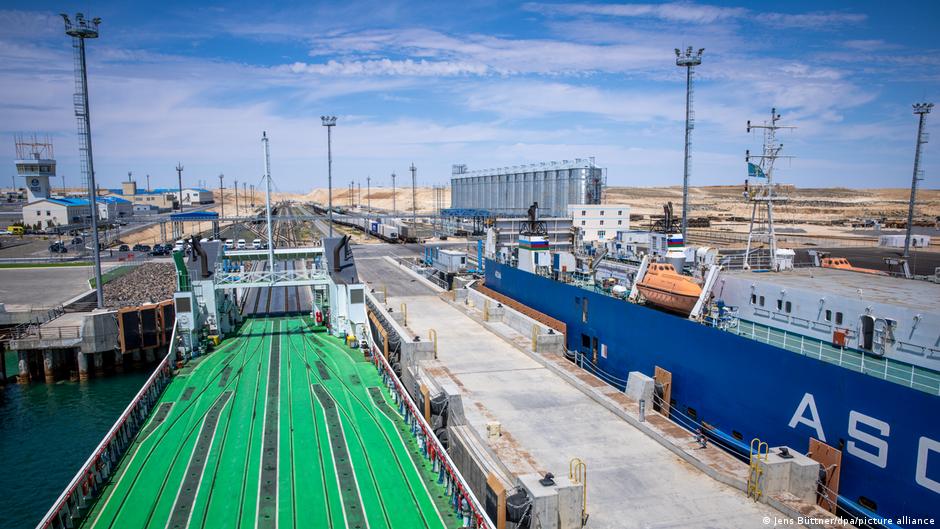
On the morning of October 6, drones hit two commercial ships off Bulgaria's Black Sea coast, sinking one of the ships and causing alarm and outrage in both Bulgaria and the EU. The drone attacks come at a time when the EU is pushing for Bulgaria to become a key entry point for goods imported from Asia to the bloc via the trade route known as the Middle Corridor. The Middle Corridor — which the EU also refers to as the Trans-Caspian Transport Corridor — connects Europe and Asia.
It begins in China and runs through Kazakhstan, Azerbaijan, Georgia and Turkey before reaching the EU. Although it is mostly made up of railways and roads, short sections of the corridor cross the Black Sea and Caspian Sea. The EU has this year declared its intention to bet big on this trade route, a move that could have consequences for Bulgaria's railways, roads and ports.
Bulgaria's land border crossing with Turkey, Kapitan Andreevo, is already one of the busiest in Europe. Lines of trucks can frequently be seen queuing at the checkpoint. The country also has two strategic ports on the Black Sea — Varna and Burgas — and a new section of a railway line between Istanbul and the Bulgarian border is set to open this fall.
In September, EU Commissioner for Enlargement Marta Kos called Bulgaria "Europe's Connectivity Gateway" due to its strategic location on this route. A few months earlier, Kos said that the Middle Corridor could considerably cut transport times from Asia to Europe from 45 days to just 15 days and is safer than the two traditional routes for goods being transported to Europe from Asia. One of these was an overland route via the Northern Corridor through Russia.
Trade along this route dropped sharply after Russia's full-scale invasion of Ukraine in February 2022. The other route, sometimes referred to as the Ocean Route, sees goods traveling by ship through the Red Sea and the Suez Canal. But fears of disruption caused by wars and instability in the Middle East mean that many goods are now being shipped all the way around Africa — a journey that takes around 45 days.
That results in delays and costs for businesses and consumers alike. All of this explains why the Middle Corridor suddenly seems so attractive — a fact confirmed by Vessela Tcherneva, deputy director of the European Council on Foreign Relations, who is based in Sofia, Bulgaria. "The Middle Corridor is a project that basically avoids both war theaters that we have near Europe," Tcherneva told DW.
Extract — continue reading at the source.