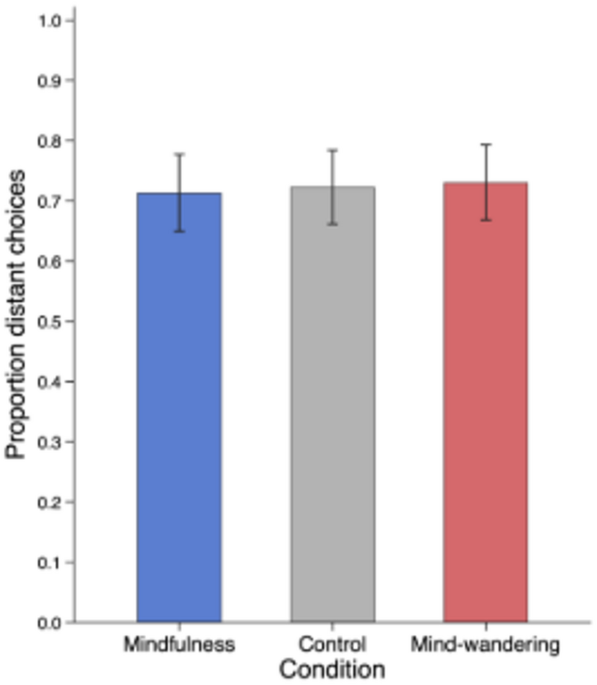
One essential aspect of mindfulness practice is to help people focus on the present moment. Although this present-focused attention has been linked to several positive outcomes, it also raises the possibility that mindfulness could increase present bias, with potentially negative consequences for decision-making. Across three laboratory studies and one longitudinal field study, we examined whether mindfulness meditation affects intertemporal choice.
In the laboratory studies, participants completed brief guided mindfulness exercises before making economic decisions involving trade-offs between smaller immediate rewards and larger delayed rewards. In our field study, participants completed an eight-week mindfulness course offered by an established mindfulness institute, and they made intertemporal choices before and after their training. Across all four studies, mindfulness did not increase present bias or meaningfully alter intertemporal decisions.
Breathing in, I calm body and mind. Dwelling in the present moment I know this is the only moment. Mindfulness is no longer confined to yoga studios and meditation retreats; it has become mainstream in boardrooms and executive training programs worldwide.
Many Fortune 500 companies—including industry giants like Google, Apple, Nike, and Goldman Sachs—have adopted mindfulness initiatives aimed at sharpening leaders’ attention, reducing stress, and improving decision-making1,2. Yet, despite its widespread popularity and enthusiastic endorsements by millions of professionals, mindfulness practice has recently come under scrutiny for potential unintended consequences. Some scholars and commentators have raised concerns that mindfulness, by enhancing focus on the present moment, might unintentionally encourage present-biased decision-making—leading people to prioritize immediate gratification at the expense of future benefits3,4,5,6.
Given mindfulness’s rapid and extensive integration into corporate cultures, rigorously investigating its impact on intertemporal choice is important for both organizational effectiveness and individual well-being. Mindfulness, defined as “the awareness that arises through paying attention, on purpose, in the present moment, non-judgmentally”7, has positive effects that have been well-established across many domains. Mindfulness interventions have been frequently applied in clinical contexts—among groups diagnosed with, or considered at risk for, health-related conditions—to address anxiety, personality disorders, substance abuse, stress, chronic pain, and other conditions8.
Several reviews have summarized this literature and generally support the clinical effectiveness of mindfulness-based interventions (see9,10,11,12,13,14,15,16,17, with continued support from recent research (see16,18,19,20,21,22. Moreover, the positive effects of mindfulness are not limited to clinical contexts. Brain imaging studies have found a positive relationship between mindfulness and neural functions related to well-being23,24,25.
Extract — continue reading at the source.