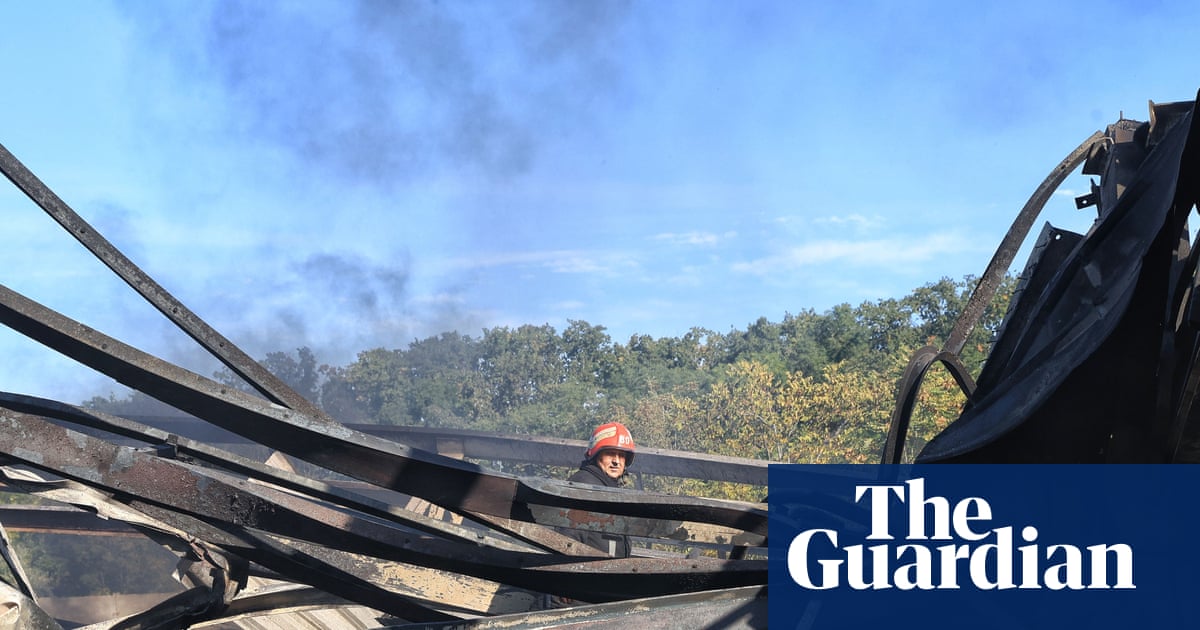
Missile alerts are costing Ukraine an estimated $45m (£34m) for every hour they bring business to a halt, according to the country’s economy minister, as Kyiv searches for ways to keep the economy running under an intensifying Russian bombardment. Russia has increasingly targeted the infrastructure underpinning Ukraine’s economy, striking industrial sites, warehouses, logistics hubs and datacentres in what Oleksandr Kravchenko, the minister for economy and the environment, described as an effort to “destroy pretty much the entire economy”. Speaking from the heavily protected government building in Kyiv, Kravchenko, a former McKinsey executive who joined the government in the summer, said the attacks were forcing large parts of the economy into repeated standstills as workers were sent to shelters, with sirens lasting up to 10 hours a day.
To ease the economic costs, the government recently introduced a new two-tier warning system designed to keep businesses operating during prolonged air raid alerts. A “red” alert warns of a missile threat and requires people to seek shelter, while a “yellow” warning is used for drone threats, allowing many businesses to remain open. More than half of businesses were continuing to operate during yellow alerts, Kravchenko said.
But a yellow alert is no guarantee of safety. That danger was made clear on Monday, when a Russian jet-powered drone struck the National Academy of Sciences in central Kyiv during a yellow alert, killing two people while staff were still inside working. It is one of the difficult trade-offs Ukraine faces as it tries to keep normal life moving while protecting people from an escalating campaign of Russian strikes.
Kravchenko said Russian attacks this year alone had caused an estimated $10bn in damage to fixed assets, with steel plants, warehouses, logistics infrastructure and, most recently datacentres, among the targets. Russia has also effectively blockaded Ukraine’s Black Sea ports, which before the blockade carried the bulk of the country’s exports. The minister believed the government was better prepared this year for what could be the “hardest, the harshest winter” of the war, with further pressure expected on energy supplies, infrastructure and businesses already weakened by months of strikes.
To protect against future strikes, the government is now discussing ways to allow more private companies to purchase Ukraine’s air-defence system, the minister said, although he cautioned that businesses could never fully protect themselves from Russian missiles and drones. The ongoing damage from strikes has added to an already severe strain on the state’s finances. The president, Volodymyr Zelenskyy, has recently put Ukraine’s remaining budget shortfall this year at about $27bn, a figure that has prompted questions among some European governments over how the gap emerged, despite the EU having already agreed a €90bn loan package for Ukraine covering 2026 and 2027.
Kravchenko said the government had since narrowed the shortfall to $20bn through spending cuts and by identifying additional domestic reserves. Kyiv was now seeking further support from the EU, Japan, Canada and the UK, including potentially bringing forward loans that had been earmarked for next year, Kravchenko said. Kravchenko dismissed suggestions that the shortfall was the result of mismanagement or corruption.
Extract — continue reading at the source.