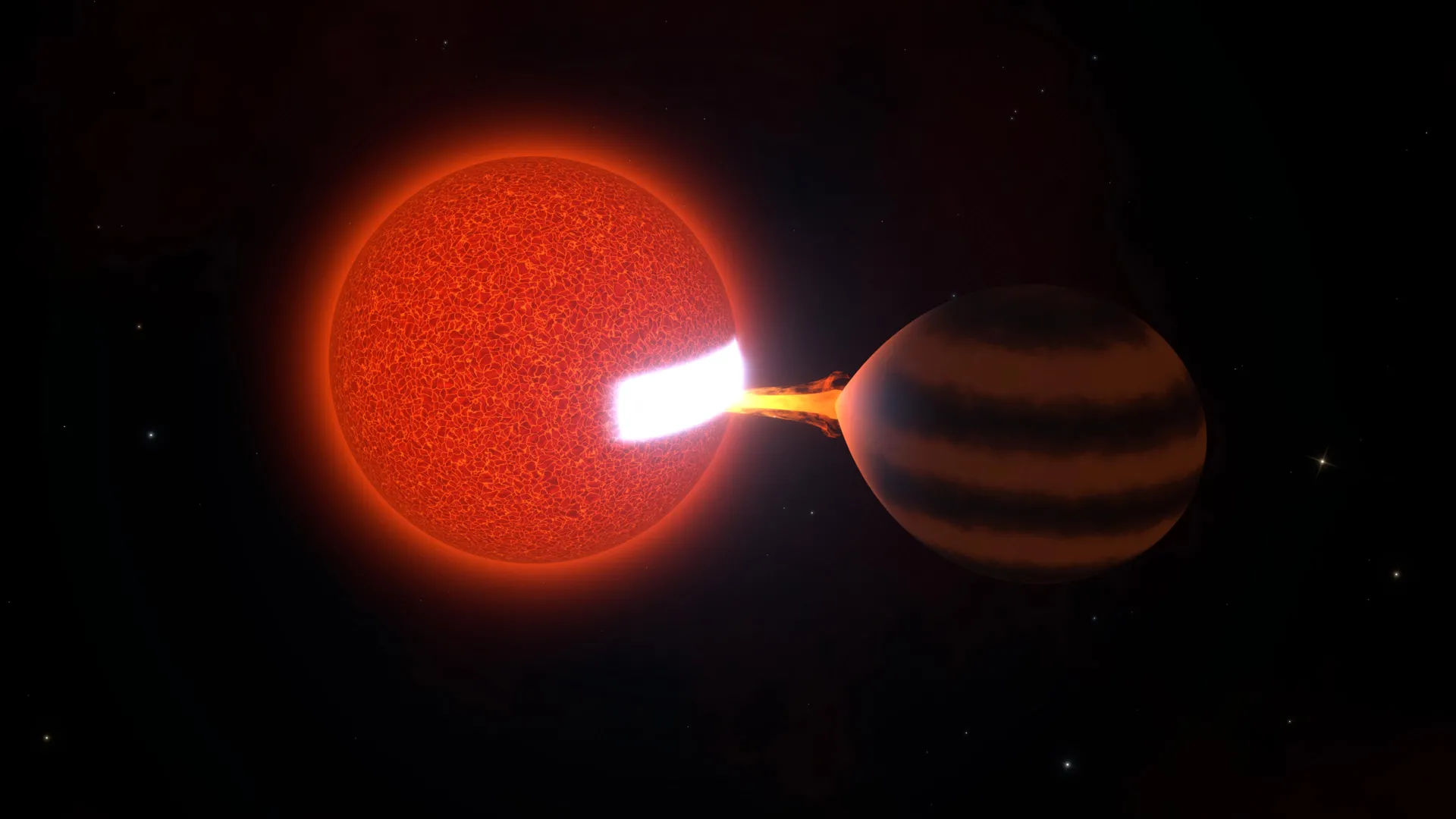
Astronomers have discovered an unusual star system about 300 light-years from Earth where a small star is gradually consuming a nearby brown dwarf. Instead of swallowing its companion in one dramatic event, the star is steadily pulling material from it, creating a cosmic feeding process that could continue for billions of years. Most planets, including Earth, travel around their stars in relatively stable orbits.
But these peaceful arrangements can sometimes end violently. If a planet ventures too close to its host star, the star's gravity can drag it inward and eventually engulf it. Scientists have observed many planetary systems with stable orbits, along with a small number of stars caught rapidly swallowing their planetary companions.
Now, researchers have identified something that falls between those two extremes. In a study published October 5 in Nature Astronomy, an international team led by scientists at MIT describes a star that is slowly feeding on a brown dwarf, an object more massive than a typical planet but not massive enough to sustain the hydrogen fusion that powers ordinary stars. The system, designated ZTF J0440+2325, lies within our Milky Way galaxy approximately 300 light-years away.
It is the first observed example of a low-mass star steadily drawing material from another low-mass object. Even more remarkably, the transfer of material appears to be happening so slowly that the star could continue feeding on its companion for hundreds of thousands of years, potentially even billions. "When we think of stars interacting with planets or brown dwarfs, the picture is always that the star eventually swallows the other thing," says Kevin Burdge, assistant professor of physics at MIT.
"This is what will happen to the Earth when the sun becomes a red giant. But here, we've found an alternative: Instead of swallowing the thing up, the star can gradually eat it, for billions of years." The MIT research team also includes Aaron Householder, Kaitlyn Shin, Saul Rappaport, Joheen Chakraborty, and Emma Chickles. Additional collaborators contributed from Caltech, the University of Hawaii, the Instituto de Astrofísica de Canarias and Universidad de La Laguna in Spain, and the Harvard-Smithsonian Center for Astrophysics.
A Mysterious Signal That Puzzled Astronomers for Years The first clue to this unusual stellar relationship came from the Zwicky Transient Facility (ZTF), an astronomical survey that searches for objects whose brightness changes over time. Operating with a telescope at Palomar Observatory in California, ZTF repeatedly photographs large sections of the night sky. Its sensitive camera can detect sudden or unusual changes in light that may indicate powerful cosmic events, including exploding stars called supernovae, gamma-ray bursts, and collisions between neutron stars.
Extract — continue reading at the source.