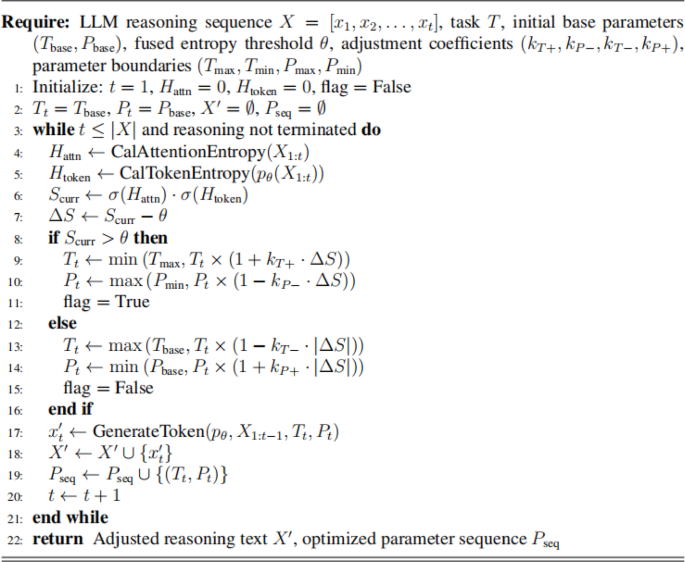
Large language models often suffer from logical hallucinations, repetitive generation loops, and imbalanced reasoning efficiency during complex mathematical reasoning. Existing static prompting and explicit intervention methods cannot dynamically regulate the decoding process based on the model’s real-time reasoning state. This paper proposes the Implicit Signal Self-Tuning (ISST) framework.
It synchronously computes two internal uncertainty metrics during decoding: attention distribution entropy and token confidence entropy. These are fused via Sigmoid multiplication to obtain a unified entropy value. This value quantifies the risk level at each reasoning step.
When the unified entropy exceeds a threshold, the framework activates an exploration mode. It increases the sampling temperature and narrows the top-p sampling interval to break reasoning loops. When the entropy falls below the threshold, it switches to an exploitation mode.
Parameters are gradually restored to baseline values. This balances reasoning accuracy with token consumption. Validation is conducted on multiple mathematical datasets including AIME24, AMC23, and MATH500.
Models ranging from 1.5B to 7B parameters are tested. The framework achieves an average 50% reduction in repetitive generation rate. It reduces token consumption while maintaining reasoning accuracy.
No modification to the model backbone is required. This provides a lightweight new approach for adaptive reasoning optimization in large models. College of Computer Science, Sichuan Normal University, Chengdu, 610101, China The authors declare no competing interests.
Extract — continue reading at the source.