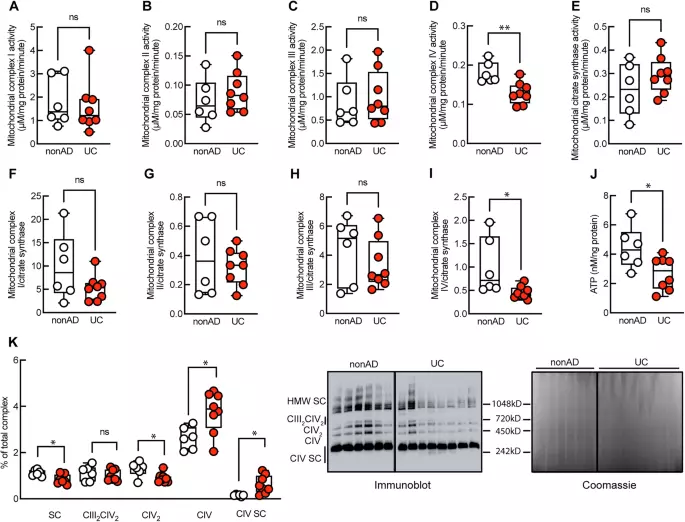
Mitochondrial complex IV (CIV) is an integral part of the mitochondrial electron transport chain (ETC) and plays a pivotal role in maintaining mitochondrial function. In contrast to the long-standing recognition of its dysfunction in Alzheimer’s disease (AD), the exact role of CIV deficit in the pathogenesis of this neurodegenerative disorder remains poorly defined. In this study, by incorporating clinical resources, mouse- and human-based models of AD risk, and a genetic approach to bypass defective CIV via the ectopic expression of alternative oxidase (AOX), we examined whether CIV deficits are a pathogenic driver of or a beneficial adaptation to AD-associated pathologies.
Our results showed a clinicopathological association between neuronal CIV dysfunction and pathological characteristics of AD. Further experiments linked defective CIV to the development of mitochondrial dysfunction and synaptic loss in the tested mouse- and human-based models of AD risk. In addition, a reciprocal relationship between CIV dysfunction and amyloid pathology was determined.
Lastly, a proteome-wide association study (PWAS) using genetic data from large-scale AD cohorts identified that downregulation of COX11, a crucial CIV assembly factor, confers susceptibility to AD risk. Collectively, our findings suggest that CIV dysfunction is a detrimental pathology contributing to AD-associated mitochondrial and neuronal damage. The dual role of CIV dysfunction, both as a consequence of and a contributor to amyloid toxicity in AD pathogenesis, further justifies the therapeutic potential of strategies targeting CIV deficits to diversify the tools for prevention and treatment of this neurodegenerative disorder.
The mitochondrial cascade hypothesis of Alzheimer’s disease (AD) posits a link between mitochondrial dysfunction and neuropathology [1]. The causal nexus, however, is obscured by the complex reciprocal relationship between mitochondrial dysfunction and AD-associated pathological molecules such as amyloid beta (Aβ) [2,3,4,5,6]. As a result, the scientific community currently remains divided on the precise role of mitochondrial crisis in AD etiology.
This contention is exemplified by an ongoing debate centered on whether mitochondrial complex IV (CIV) deficits actively contribute to the pathogenesis of AD, or are merely an adaptive response to amyloidosis and neurodegeneration in an AD-related context [5, 7,8,9,10,11]. The resulting ambiguity further fuels the debate on whether mitochondrial CIV deficits are detrimental or beneficial to the risk of this neurodegenerative disorder. Mitochondrial CIV, together with other mitochondrial complexes including complexes I (CI), II (CII), and III (CIII), constitute the enzymatic components of the mitochondrial electron transport chain (ETC), converting energy sources into a proton gradient for ATP production through oxidative phosphorylation (OXPHOS) [12, 13].
In addition to its importance to mitochondrial bioenergetics, CIV also modulates cellular activities through its regulation of reactive oxygen species (ROS) production and Ca2+ signaling pathways [14,15,16]. In past decades, CIV deficits have been repeatedly identified in patients as well as cell and animal models of AD [7, 8, 10, 17,18,19,20,21,22,23]. In addition to CIV vulnerability to Aβ toxicity, emerging evidence also implicates an impact of mitochondrial CIV deficits on the development of amyloidosis.
Extract — continue reading at the source.


