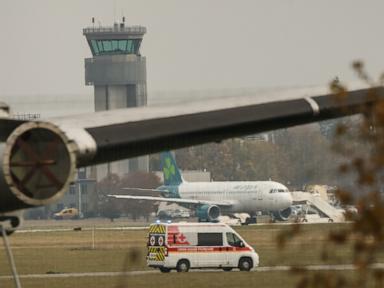
Authorities say that bomb threats have targeted more than a dozen flights in Europe, leading to a slew of emergency landings and military escorts in some cases MILAN -- Bomb threats targeted more than a dozen flights in Europe on Thursday, leading to a slew of emergency landings and military escorts in some cases, authorities said. No hazardous or suspicious materials have been found in what a British official called “malicious" hoaxes. Several similar threats targeted planes earlier this week, prompting searches and diversions.
Europe has experienced a slew of other disruptions recently, such as attacks on supermarket refrigeration systems, drone incursions and mysterious triggers to alert apps. While fake bomb threats are relatively common, it is unusual to see so many in a single day. They come at a time of increased geopolitical tensions and warnings from authorities that Russia may be ramping up so-called hybrid threats in Europe.
It wasn't known whether this week's threats were linked, who sent them or what they hoped to achieve. An email containing the threat to Rome-bound planes was sent on behalf of a group that described itself as anti-feminist, according to a copy provided by an airport official and reviewed by The . An official from another European airport said the threat they received also came from a group calling itself anti-feminist, and used some of the same language.
It wasn't clear if the same group sent the two threats. Both officials spoke on condition of anonymity because they weren’t authorized to share the information. At Rome's airport, travelers whose flights weren't affected seemed to take the threats in stride.
"Probably this idea I have about traveling in Europe will change in the near future, but let’s see how it goes.” Alex Langenkamper, a 38-year-old German headed to Munich, said “crazy people” exist and will in the future. Meanwhile, Michael Romano, a 54-year-old traveler headed to Colombia, expressed concern about the world moving toward war. "This is all new, so it is a little bit scary.” Jacob Funk Kirkegaard, senior fellow at the Bruegel think tank in Brussels, said the threats were “stress-testing” how European governments and airport officials respond, and whether their responses were coordinated.
The idea behind the threats “appears to be to sow chaos, uncertainty, about the reliability of air traffic across Europe” and could have “cascading effects” — like economic damage and costs related to inspection, investigation and cleaning aircraft. Joji Waites, who heads flight safety at the British Airline Pilots’ Association, said the industry has put in place “proved mechanisms” for dealing with such threats, including a team of assessors to grade the level of threat in a red-amber-green color-coding system, quick notification of flight crews, and the evacuation of planes on the ground. Each flight disruption could cost airlines as much as $250,000, on a par with the possible costs of dealing with an unruly passenger, said Philip Baum, a visiting professor of aviation security at Coventry University in England.
Extract — continue reading at the source.