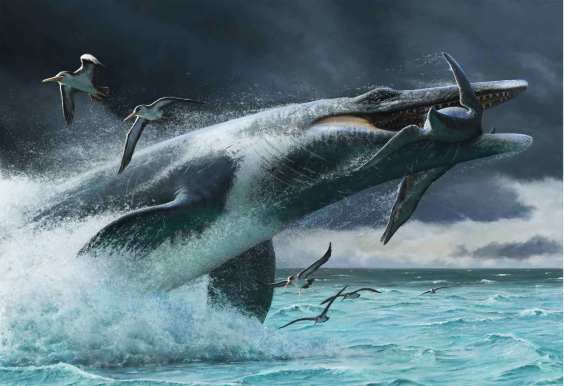
Even the fearsome plesiosaurs lived in terror of larger predators, like mosasaurs. The largest of these massive aquatic reptiles could grow as big as 56-feet-long, scooping up their doomed prey in a mouth lined with razor-sharp teeth. As if that weren’t terrifying enough, a new study published in Current Biology finds they were pretty fast, too.
A team of researchers led by paleobiologist Kiersten Formoso of Rutgers University compared two major groups of mosasaurs: the russellosaurines and mosasaurines. While both were enormous, the tail shapes of the two families differed slightly. Russellosaurines had a slightly longer tail section compared to mosasaurines, which may be a sign the two families had different hunting strategies.
Read more: “How Dinosaur Skeletons Became So Expensive” To find out, the team used nearly complete mosasaur skeletons to model different swimming styles, filling the gaps with data from their distant relatives, the komodo dragon. The researchers were most interested in comparing how well the two groups performed a move they referred to as a “slam start”—a powerful burst of speed created by curling the tail back and slamming it against the water to accelerate. According to their models, russellosaurines like the tylosaur were more adept at the explosive tactic compared to their relatively more sluggish mosasaurine relatives.
They were capable of accelerating to 15 miles per hour with a single tail stroke. That doesn’t mean the mosasaurines were slow, however. “Its tail was built for sustained, tuna-like swimming rather than sudden bursts,” Formosa explained in a statement. Still, for the unlucky plesiosaurs swimming in the prehistoric oceans it offers a pretty grim choice—die fast or die slow.
Subscribe to our free newsletter. Lead Image: Henry Sharpe/Formoso Lab/Rutgers University
Extract — continue reading at the source.
/https://tf-cmsv2-smithsonianmag-media.s3.amazonaws.com/filer_public/5a/2d/5a2d2d01-d4ad-4e91-b743-52bae6648a07/boat_crossing_bubble_barrier_-_credits_the_great_bubble_barrier.jpg)
/https://tf-cmsv2-smithsonianmag-media.s3.amazonaws.com/filer_public/a7/7b/a77be531-cb07-4a9e-a6dc-155b6c26f63d/saint-helena-plantation-house-jonathan-the-tortoise-by-kevin-gepford-02.jpg)