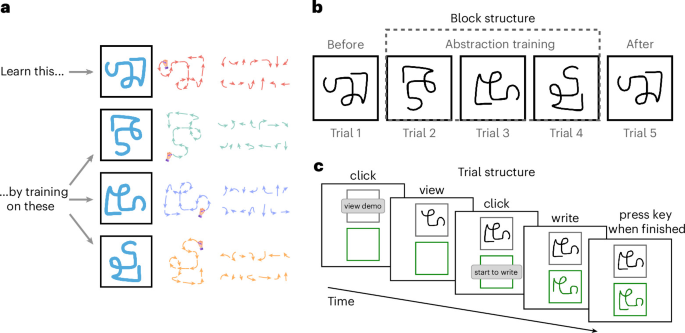
The ability to abstract the invariant structure of an experience while discarding incidental details underlies generalization across virtually every domain of human cognition, from vision and language to concept learning. Yet whether the motor system generates such abstractions and whether they causally contribute to skilled performance remain open questions. Here we introduce a paradigm in which human participants learned novel movement patterns by precisely copying unfamiliar handwritten characters.
To examine the role of motor abstractions in this form of learning, participants were trained on markedly rotated versions of the characters, which recruited substantially different lower-level movements while still maintaining the relevant abstract movement trajectory. Across 11 experiments, abstraction training drove robust performance improvements that were comparable to having repetitive practice on the canonical form of each character. Moreover, this effect was largely motoric in nature: it did not require a visual template, sustained trajectory feedback or mental imagery, and was sensitive to the sequential structure of the movement trajectory.
These findings establish a causal role for abstractions in motor learning, revealing that the motor system probably deploys abstractions in the earliest stages of skill acquisition. This is a preview of subscription content, access via your institution Access Nature and 54 other Nature Portfolio journals Get Nature+, our best-value online-access subscription Receive 12 digital issues and online access to articles Prices may be subject to local taxes which are calculated during checkout All data and materials are available via OSF at https://osf.io/2gw5c (ref. 62). All code is available via OSF at https://osf.io/2gw5c (ref. 62).
Computation and cognition: issues in the foundations of cognitive science. Brain Sci. 3, 111–132 (1980). B., Kemp, C., Griffiths, T.
How to grow a mind: statistics, structure, and abstraction. Science 331, 1279–1285 (2011). Quilty-Dunn, J., Porot, N. & Mandelbaum, E.
The best game in town: the reemergence of the language-of-thought hypothesis across the cognitive sciences. Brain Sci. 46, e261 (2023). Dehaene, S., Al Roumi, F., Lakretz, Y., Planton, S. & Sablé-Meyer, M.
Extract — continue reading at the source.


