Rising rates of mental health disorders have increased demand for scalable, non-pharmacological interventions. Interactions with animals can improve emotional wellbeing across diverse populations, yet the mechanisms responsible for these benefits remain poorly understood. Most research focuses on human outcomes while treating the animal as a passive component of the interaction, despite human–animal interactions being inherently reciprocal.
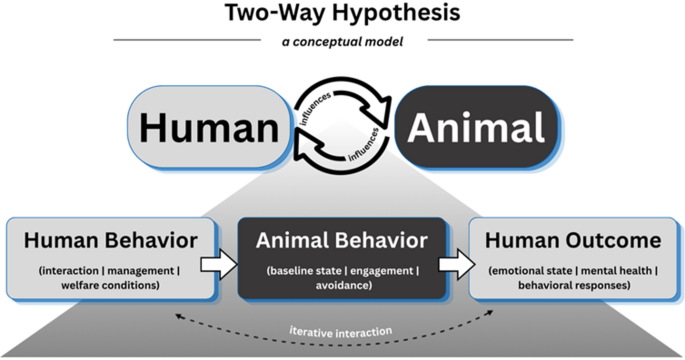
We therefore propose the Two-Way Hypothesis, which predicts that human behavior shapes animal behavior, which in turn contributes to variation in human emotional outcomes. We experimentally tested this hypothesis in 61 adolescents who participated in standardized interactions with miniature equines (horses and donkeys) under manipulated tactile conditions (petting or scratching). Emotional state was assessed before and after the interaction, and equine behavioral responses were recorded during the interaction.
Scratching increased affiliative lip-wiggling behavior and reduced voluntary disengagement (walking away) compared with petting. In turn, observing lip wiggling predicted greater reductions in loneliness, whereas observing walking away predicted greater reductions in sadness. These findings provide experimental support for the Two-Way Hypothesis, demonstrating that human interaction style can influence animal behavior and that this behavioral variation corresponds to differences in human emotional outcomes.
This framework provides a tractable basis for investigating the mechanisms underlying animal-assisted interventions. Human-animal interactions are widely used to support mental health in contexts ranging from clinical therapy to educational and community programs. These approaches, often described as animal-assisted interventions (AAIs) and more recently as animal-assisted services (AAS)1, intentionally incorporate animals into structured activities designed to improve human wellbeing.
They have been associated with improvements in mood, emotional regulation, and symptoms of depression, anxiety, and post-traumatic stress2,3,4,5,6,7,8. These benefits have been reported across diverse populations, from children to adults, suggesting that AAIs may represent a broadly applicable approach to supporting emotional health3,9,10,11. However, findings across studies vary considerably, pointing to an incomplete understanding of the mechanisms through which these interactions produce their effects2,12,13,14.
One reason for this gap is that studies of human-animal interaction typically evaluate human outcomes without accounting for variation in the animal’s behavior during the interaction. Animal welfare is generally treated as an ethical prerequisite or control variable rather than a potential driver of variation in human responses, thereby framing animals as passive components of the interaction rather than responsive participants. Recent conceptual work has begun to challenge this view, emphasizing that animals in these contexts are not passive tools but active participants whose behavior can shape the quality and outcomes of interactions1,15.
Extract — continue reading at the source.


