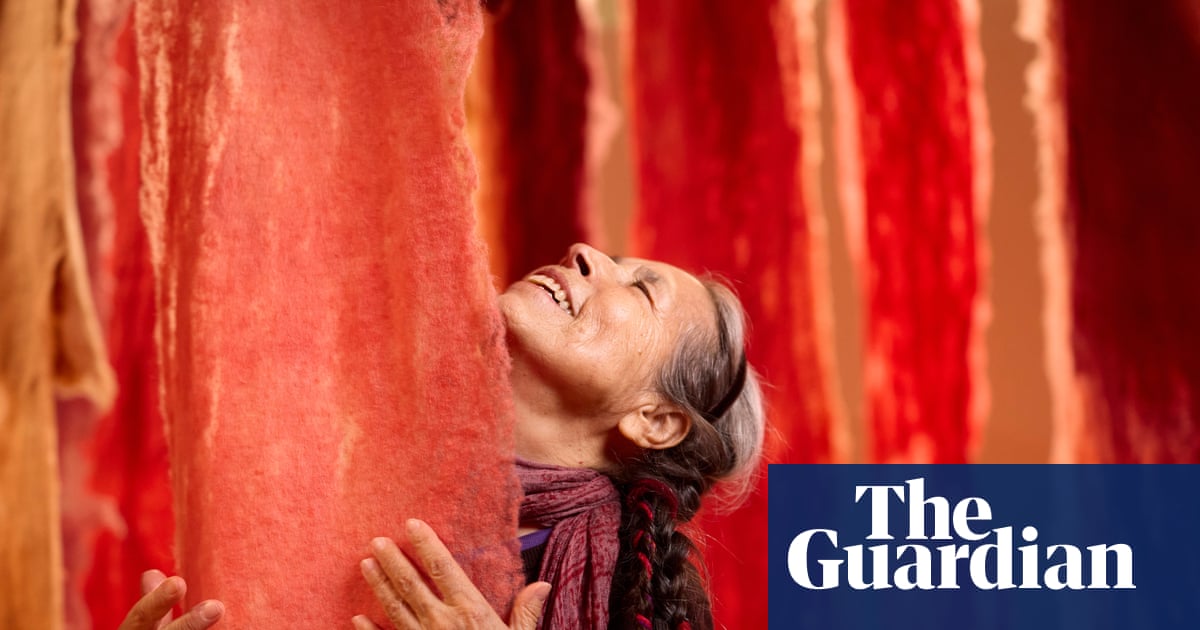
She had come from Santiago on a British Council scholarship to study at the Slade School of Art, and her stay was supposed to be so brief that she didn’t even unpack her suitcase. Then, in September 1973, General Augusto Pinochet’s military coup overthrew Chile’s democratically elected president, Salvador Allende. Vicuña was one of a handful of Chilean students in London immediately expelled from their universities and expected to leave Britain.
At a Home Office hearing, her pro-bono lawyers argued that she would be killed if she returned to Chile, and showed the judges her recently published art and poetry book, Saborami, which documented the aftermath of the coup. The judges granted her asylum. Wearing a knitted hat, she speaks softly and sagely, like a shaman offering advice – small and fragile, but with big, existential ideas about life and art.
More than half a century since her arrival in London, Vicuña, now 78 and one of Latin America’s most renowned artists, poets and feminist activists, is returning – specifically to Stepney Green, where she lived as a young artist – for her first major UK exhibition, at the Whitechapel Gallery. The London Vicuña encountered in the 1970s was very different from the image of “swinging London” exported around the world. There was a feeling of sadness, of not being able to realise one’s full potential.” But she began meeting exiles from failed revolutions across Africa, the Middle East, Greece and Latin America, found a thriving art community, and published her first book in London after it had been censored in Chile.
It also returns to her political life as a young artist speaking at trade union gatherings on the top floor of English pubs. A room is dedicated to Artists for Democracy, which Vicuña co-founded in 1974 with Guy Brett, David Medalla and John Dugger in solidarity with Chile and other liberation struggles worldwide, bringing together never-before-seen documents, photographs and printed materials. Shocked that people were discussing money while artists were being killed in Chile, Vicuña stood up to speak.
Brett, Medalla and Dugger, sitting at the back, sent her a note afterwards. During her exile, she left pieces with friends in London, Chile and Bogotá; one trunk contained 400 sculptures, eventually thrown away. She began making what she calls precarios in the 1960s from sticks, feathers, leaves, stones, bones and debris – deliberately fragile, impermanent works, a response to standing as a 17-year-old on a Chilean beach, in the shadow of an oil refinery built over an ancestral burial ground, suddenly aware of the relationship between sea, wind and objects.
The only surviving precario from her London years is in the show. It’s the belief that life itself is poetry, and poetry is life. Disappearance is regeneration.” Her quipus, meanwhile, are made from knotted and unspun fibre, drawing on an ancient Andean system of recording and communication.
Extract — continue reading at the source.


