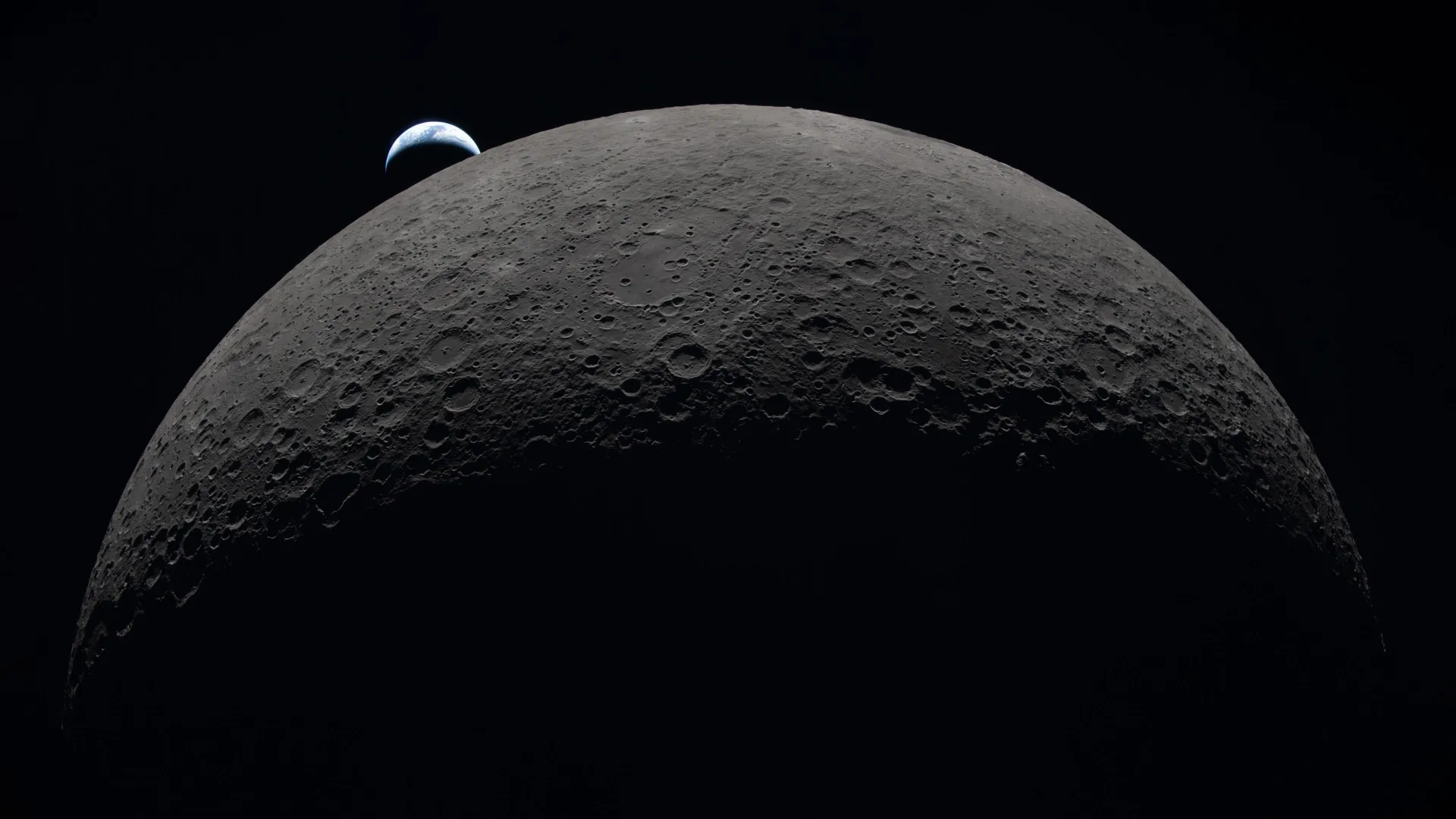
NASA scientists say some microbes carried into space by human explorers may be able to survive in sheltered, shadowed areas near the Moon's South Pole. The findings, published on Aug. 19, 2026, in Science Advances, underscore the importance of understanding how long Earth microbes can persist in extreme lunar environments. As people establish a more permanent presence on the Moon, contamination from astronauts could make it harder for scientists to separate ancient lunar chemistry from material introduced by humans.
Researchers say the same issue will matter when missions eventually search for signs of life on Mars. "Humans are natural explorers, and with them come their voices, their memories … and their microbes," said Prabal Saxena, a planetary scientist who led the study from NASA's Goddard Space Flight Center in Greenbelt, Maryland. "For some scientists, myself included, that reality can be unsettling.
But it also creates an opportunity to turn an imperfect situation into a useful experiment." Humans inevitably carry microbes with them. On average, about 1 million bacteria live on every patch of skin roughly the size of a pencil eraser. Some of these organisms can escape from spacesuits and habitats into the surrounding environment.
That creates a challenge for scientists hoping to study chemical evidence connected to the Moon's ancient geology or possible biology. At the same time, the researchers argue that the Moon could serve as a valuable natural laboratory. Carefully monitored shadowed regions near the South Pole could allow scientists to test the real limits of microbial survival under conditions that are extremely difficult to reproduce on Earth.
Before those experiments can begin, however, researchers need to establish a clear baseline showing what contaminants humans introduce. "We need to understand what was there before us, because when we go to Mars to search for signs of life beyond our planet, we will want to make sure it's not stuff we brought," said Andrew Needham, a NASA Goddard-based paper co-author who is an Artemis contamination-control scientist for lunar samples. Even rigorous sterilization cannot eliminate every hardy organism.
One example is Aspergillus niger, a fungus that commonly grows in warm, humid environments such as bathrooms and heating, ventilation, and air conditioning systems. Astronauts have collected samples of the fungus aboard the International Space Station, and previous experiments have shown that it can also survive outside the station. Aspergillus niger was one of five microbes examined in the new study because of its demonstrated resilience in spaceflight conditions.
Extract — continue reading at the source.