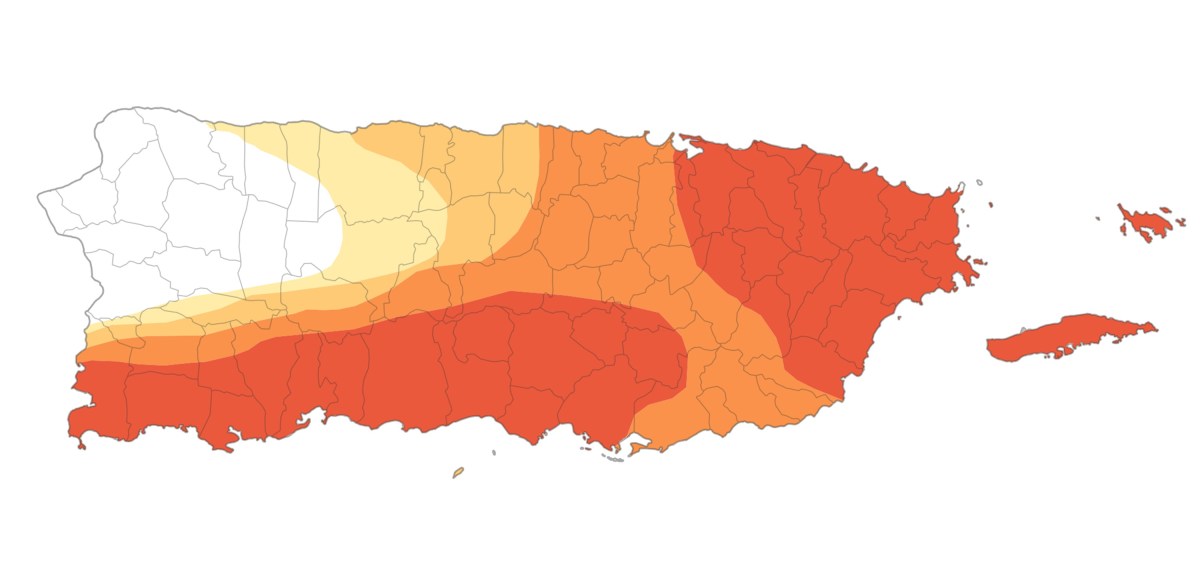
A newly released NASA map has highlighted the scale of drought conditions across Puerto Rico, where hot and dry weather has led to water shortages, agricultural concerns, and emergency measures affecting tens of thousands of residents. Published by the NASA Earth Observatory on September 2, the map depicts drought conditions across the United States territory on August 25 using data from the United States Drought Monitor, a partnership involving the National Drought Mitigation Center, the U.S. Department of Agriculture, the National Oceanic and Atmospheric Administration (NOAA), and NASA.
NASA said that "rainfall deficits and high temperatures have created unusually dry conditions and have spurred water shortages on much of the tropical archipelago." At the time of reporting on Monday, 75.2 percent of Puerto Rico is reported to be experiencing drought conditions, according to the U.S. Just under half (41 percent) is classified as being in extreme drought, while 21.3 percent is in severe drought. More than 3 million people are living in drought-affected areas, as per the U.S.
Brandon Wright, senior meteorologist at satellite company ICEYE, told Newsweek that the speed of the drought's development had been particularly striking. "This is one of the worst droughts on the island since the US Drought Monitor began in 1999," he said. A White House official told Newsweek in early August that the administration was “closely” monitoring the situation in Puerto Rico and that it had not received any requests from the U.S.
Federal Emergency Management Agency (FEMA) for assistance. Newsweek has contacted the White House, FEMA, Puerto Rico's Bureau for Emergency Management and Disaster Administration (NMEAD), and the Puerto Rico Tourism Company (CTPR) for comment via email. Meteorologist Wright told Newsweek that the latest drought situation in Puerto Rico is “definitely one of the fastest onsets.” He noted that just three months ago, only about a third of Puerto Rico was considered “abnormally dry,” whereas around 40 percent is now classified as being in extreme drought.
According to Wright, “the recent spike is the most dramatic.” A new analysis report prepared for Newsweek by geoscientist Elena Maksimovich, CTO and head of climate data at Everloop, a sustainability and climate-risk consultancy, found that the summer of 2026 in Puerto Rico was exceptionally dry, though not unprecedented. According to the report, the June-July-August period of 2026 was the second driest summer season in Puerto Rico since 1950, based on data from the European Centre for Medium-Range Weather Forecasts (ECMWF). The driest summer on record remains 1994, a year associated with significant wildfire activity.
The report stated that summer 2026 was "drier than normal, yet not as extreme as the summer season 1994, which was marked by wildfires." Wright said that El Niño has likely played a significant role in accelerating the drought. "El Niño is definitely a contributing factor, as it often suppresses thunderstorm activity across the Caribbean and limits Atlantic tropical season activity as well," he said, noting “the onset of El Niño as Puerto Rico should have been entering its wet season likely helped accelerate the drought.” He explained that reduced thunderstorm activity can trigger a feedback loop in which fewer clouds allow more heating, leading to further drying of the landscape. Wright pointed to temperature records in San Juan, noting that May ranked among the 15 warmest on record, with June being among the 10 warmest, while July and August were the second warmest for their respective months.
Extract — continue reading at the source.