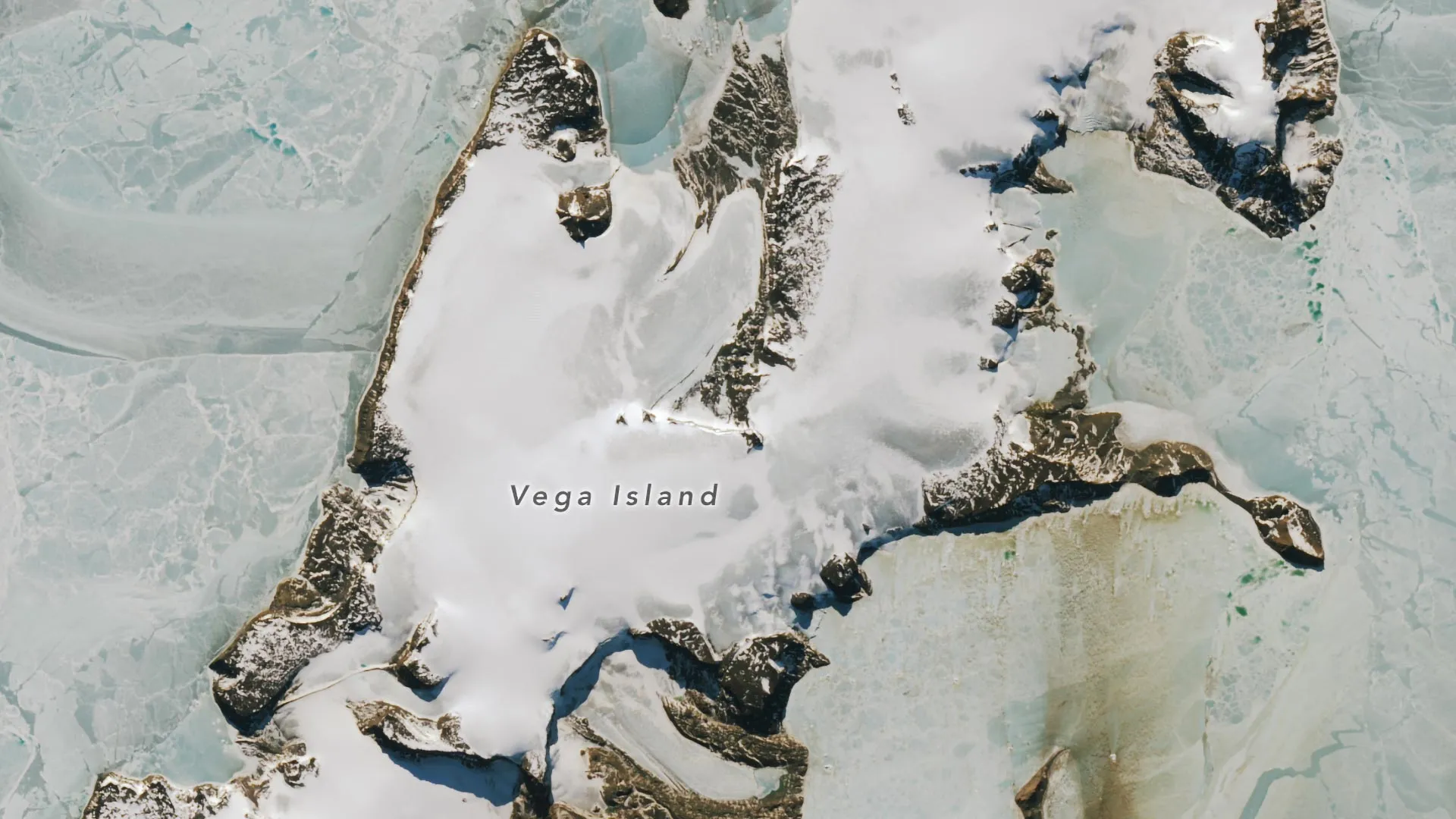
Located in the Weddell Sea, east of the Antarctic Peninsula, Vega Island has a particularly haunting appearance when viewed from above. Its rocky and icy features resemble a grinning skull seen from the side, seemingly gazing toward nearby Devil Island. But behind this unusual sight is a more serious story about the changing condition of Antarctica's glaciers.
NASA satellite images show the island during the beginning of Antarctic autumn and during spring. The images were captured by the OLI (Operational Land Imager) aboard Landsat 9 on March 22, 2025, and October 10, 2026, respectively. (Clouds obscured the island in March 2026.) Several natural landmarks create the skull's distinctive appearance. A nunatak, which is a rocky peak rising above the surrounding ice, resembles an empty eye socket.
A lateral moraine, a ridge of material left along the side of a glacier, outlines the mouth. Meanwhile, Bahía del Diablo (Devil’s Bay) Glacier forms what looks like the skull's lower jaw. The two satellite views also reveal a striking difference in snow coverage.
In March 2025, snow blanketed the icy terrain, consistent with March being the wettest month in the region. By October 2026, however, extensive sections of the island were free of snow, leaving darker glacier ice exposed. Glaciologist Mauri Pelto of Nichols College explained that unusually warm conditions during the winter of 2026, especially in June, contributed to the unusually large areas of exposed ice observed in October.
According to Pelto, the exposed surfaces on Vega Island and neighboring islands suggest that relatively little fresh snow accumulated over the winter. Some of that snow was also lost through sublimation, when ice turns directly into water vapor, and through strong winds that swept snow away. Fresh snow reflects much of the sunlight that reaches it, while darker, exposed ice absorbs more solar energy.
As daylight increases and temperatures rise, these darker surfaces are likely to warm more quickly, potentially speeding up glacier melting. Even a modest amount of new snowfall could temporarily slow that process by covering the exposed ice. Continued melting could also gradually transform the island's unsettling appearance.
Extract — continue reading at the source.


