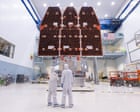
A $4.3bn space telescope that Donald Trump tried to kill is set to lift off from Florida early on Sunday as Nasa embarks on the next stage of its quest to unlock the secrets of the universe. The Nancy Grace Roman space telescope survived two rounds of proposed White House budget cuts, and will embark on a million-mile journey into deep space from a launchpad at the Kennedy Space Center at 7.26am ET, barring late technical issues or intervention from Florida’s notoriously capricious summer weather. Searching chiefly for exoplanets and clues about planetary formation, it is set to join the Hubble and James Webb space telescopes in the annals of Nasa’s storied history of space exploration.
But as next-generation equipment almost 10 years in the making, the Roman telescope, named for the space agency’s first chief of astronomy, who died in 2018, is many times more powerful than Hubble and will work to enhance the output of its stablemates, both of which continue to operate. According to Nasa, its 300-megapixel infrared camera will give Roman the same sharpness and resolution as Hubble, but with a field of view at least 100 times larger. The agency says each image will capture a patch of sky about 1.5 times bigger than the apparent size of a full moon.
Roman also contains a specialized instrument known as a coronagraph that blocks glare from stars and makes it easier to photograph planets around them in detail. Nasa said it expected the images would reveal “giant worlds that are older, colder, and in closer orbits than the hot, young super-Jupiters direct imaging has mainly revealed so far”. Roman’s destination is Lagrange point 2, a “parking spot” in space about one million miles from Earth, where it will operate in the same complex sun-Earth orbit as Webb, though the two telescopes will remain far apart.
It is not entirely a successor to Hubble and Webb, which were launched in 1990 and 2021, respectively, but was designed to support and advance their missions, while making discoveries of its own. Nasa said Roman’s large panoramas would “uncover interesting targets that Hubble could follow up on using infrared, visible, and ultraviolet light to offer a more comprehensive view”, while Webb “can then use its larger mirror and more powerful vision to deliver even more detailed, ultra-sharp observations”. Roman, meanwhile, can view regions around objects Hubble or Webb observe “to offer context”.
Its imagery, which Nasa expects will first come in early 2027 after months of calibration and tests in the telescope’s final orbit, will be made immediately public, allowing the agency, professional researchers and amateur astronomers an unprecedented opportunity for analysis. This flagship mission is designed to help astronomers explore dark matter, dark energy, and planets outside our solar system.” Julie McEnery, Nasa’s senior project scientist for the Roman mission, said the need for it was conceived at the end of the last century, although it was only in 2016 that Nasa began the development stage, and 2020 before it finally approved the entire project and commenced construction. There’s something really fundamental that we don’t understand about the nature of our universe itself, and Roman is purpose-built to address and provide the data that we need to address these questions.” If the US president had his way, Roman would never have made it to the launchpad.
A 2025 White House proposal for what analysts said would be “extinction level cuts” to Nasa’s science budget, including the axing of the Roman project, was roundly rejected in January by Congress, which restored the agency’s 2026 funding level to $24.4bn. Seemingly undeterred, the Trump administration is trying again for the 2027 fiscal year, seeking a 23% reduction in Nasa’s overall budget to $18.8bn, and a 46% chop for science projects that the Planetary Society said would lead to the termination of more than 50 missions. Sunday’s scheduled launch of Roman marks the final flight of SpaceX’s Falcon Heavy rocket, which Elon Musk’s company is phasing out along with its smaller Falcon 9 rockets to concentrate on Starship, its versatile new workhorse that is planned to eventually carry humans to Mars.
Extract — continue reading at the source.