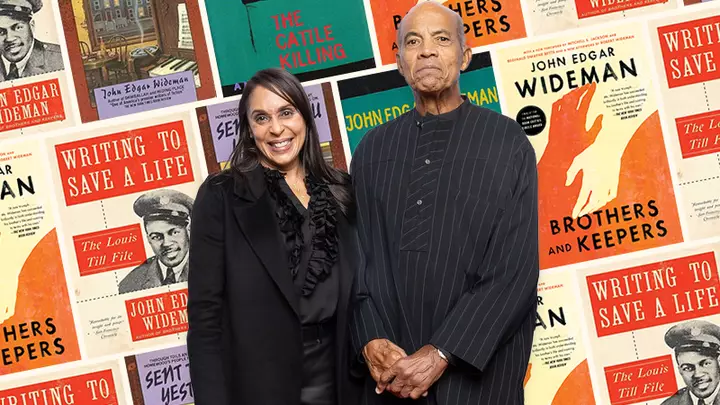
The following is an edited transcript of Natasha Trethewey’s remarks at the second annual Harper’s Magazine Awards Ceremony, where John Edgar Wideman was honored with the Lewis H. Lapham Award for Literary Excellence. The ceremony was held on Monday, October 26, 2026, at the Morgan Library & Museum.
For nearly six decades, John Edgar Wideman has been publishing essential work that grapples with the legacies of America’s troubled and fraught past, our collective history, as well as our individual trials, race and culture and politics. The ongoing quest for justice in a world that seems, it turns more and less just all of this with a ferocity and independence of mind, searing vision and moral clarity. The first book by John Edgar Wideman that I ever read was Sent for You Yesterday, the third in his renowned Homewood Trilogy, the book for which he was awarded the first of his two PEN/Faulkner Awards.
It was 1992, and I was on my way to an MFA program at the University of Massachusetts. Even though I had decided to write poetry, the person I wanted to study with was John Edgar Wideman. It was one of the best decisions I ever made—and not only because of his work, which was a tutorial in itself, but also because of the kind of teacher he was, his way of being in the world with grace and dignity, wit and a piercing intellect, even in the face of personal hardship and suffering.
I’ll never forget sitting in his office one afternoon early in my graduate career; I’d sought him out, distraught, after my famous poetry professor dismissed my work—indeed my reasons for writing—by telling me to unburden myself of being black, unburden myself of the death of my mother and to “just pour your heart out in the poems.” John listened intently, his gaze turning toward the window out of which it seemed he could see far beyond the place and moment we were in, forward and backward, across time and space. Simple as it was, his pronouncement was a turning point in my life as an aspiring writer. It was for me the feeling of being given permission by the highest authority—a writer whose own courageous reckoning in his memoir Brothers and Keepers I knew well.
This was years before I would have to grapple with my own brother’s incarceration, the divergent paths of our lives. But I would turn to it again and again for what it continued to teach me. It is a mastery of form that accomplishes a stunning melding of John’s voice with his brother Robby’s—a remarkable act of empathy, exemplary of the kind of ethical approach one must have when writing about the lives of other people, particularly those without a platform from which to tell their own story.
Many of us know the kind of damage that can be inflicted in graduate programs, and I believe John understood exactly what his encouragement could do for a young writer—particularly a young black writer. Like the title of his deeply researched and imaginative meditation on the intertwined tragedies of Emmett Till and his father, Lewis Till, Writing To Save a Life. John understood my need in order to write, to save a life: not only my own life in the aftermath of tragedy and trauma, but also the lives of the people I loved—my people—from being erased, forgotten, diminished, and shut to the margins.
Extract — continue reading at the source.