There are two classes of problems that physicists often talk about that might leave you thinking, “geez, a physicist can never be satisfied, can they?” The first is called a coincidence problem: where things that have no apparent reason for being close together actually are close together. Examples include: The second is the opposite type of problem, known as a hierarchy problem: where it seems like there is a large, unnatural, inexplicable gap between things that — if everything were equal — you might expect to be close together. Examples of that include: You might think that having both “coincidence” and “hierarchy” problems just means that physicists are always looking for trouble, and can never be satisfied.
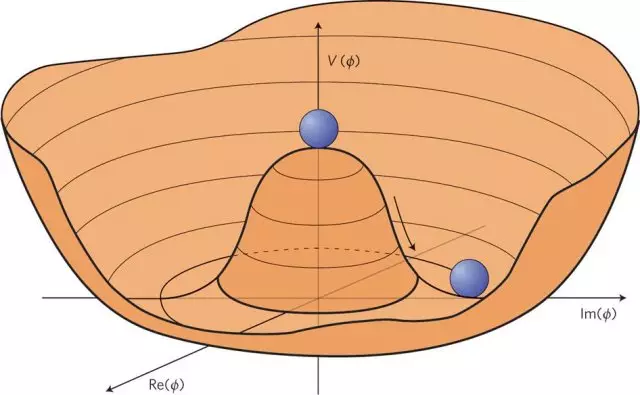
But both sets of problems are just the extreme poles of fine-tuning, and naturalness) is one often (but not always) useful way to approach it. Here’s what the big idea is all about. Explanatory diagram showing how symmetry breaking works.
At a high enough energy level, a ball settled in the center (lowest point), and the result has symmetry. At lower energy levels, the center becomes unstable, the ball rolls to a lower point – but in doing so, it settles on an (arbitrary) position and the result is that symmetry is broken – the resulting position is not symmetrical. An outcome that may seem unlikely can be made sense of if the history of the system, and a mechanism that naturally leads to that seemingly unlikely outcome, can be correctly identified.
The study of the Universe itself — both in terms of the fundamental laws that govern it as well as the ingredients that make it up — is, by definition, the study of nature. Assuming that we, as humans, can intuit what is itself “natural” is kind of a bit of hubris on our part: nature simply is what it is, and we, ourselves a product of nature, can only hope to figure out what it is and how it got to be this way. And yet, it’s been an incredibly successful approach at times.
A “natural” idea simply posits the following: In other words, the idea of naturalness is simply to state that instead of the Universe just being the way it is, full of coincidences, huge disparities, and all sorts of “fine-tunings” that had to occur for it to turn out the way it did, there ought to be mechanisms in place that led to it being the way we observe it to be. Balanced Rock, shown here in photos from before 1975 (black and white) and after 1976 (color), showcases how weathering and erosion can lead to the collapse of structures over time. At right, the structure once known as “Chip off the Old Block” fell during the winter of 1975-1976, and someday, Balanced Rock will fall as well.
However, it was created by natural processes, even if it doesn’t appear so; understanding how is the key to solving what appears, on the surface, to be a fine-tuning problem. Throughout the history of theoretical physics, and in particular during the development of the Standard Models of particle physics and cosmology throughout the 20th century, this approach turned out to often be incredibly useful. In the early days of quantum physics, people started asking questions about the electric field that surrounded the electron and how you could reconcile that with a point-like particle, which experiments supported.
Extract — continue reading at the source.