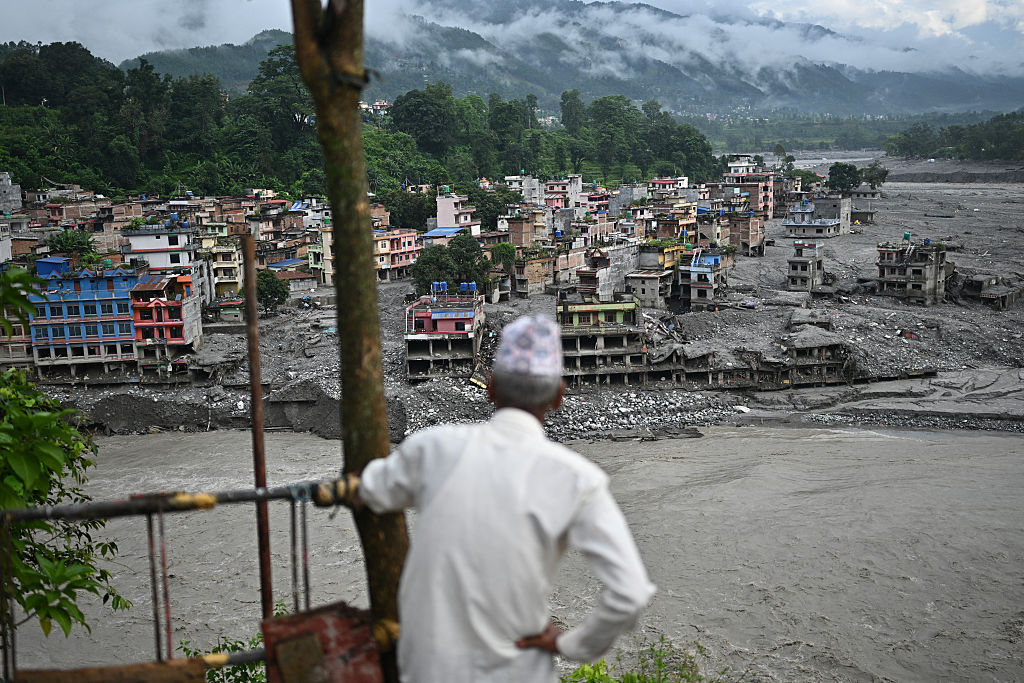
The floods in Nepal and Tibet have been terrifying: some 1,386 people have died, and around 5,000 remain unaccounted for. The flood destroyed bridges, hydropower projects and entire towns. The scale of the loss is immense but in Nepal and Tibet, the contours of such a disaster are grimly familiar.
The Himalayas have been regularly witnessing deadly flash floods. In July 2025, a flood originating in China crossed into Nepal through the Trishuli River basin and killed 19 people. Its dynamics were different, but also involved glacial meltwaters.
A flood in the Indian state of Uttrakhand in 2021 killed more than 200 people, and another flood in the Indian state of Sikkim in 2023 killed 55 people. In 2022, the floods in Pakistan affected more than 33 million people, destroyed 1.7 million homes, and killed around 1,500. What is driving such recurring events?
It would be easy to attribute the flood in Nepal and Tibet simply to climate breakdown. Nepal ranks sixth among the countries most vulnerable to climate risk, and Himalayan glaciers are melting faster as the planet warms. And climate change demonstrably contributed to other devastating events in the Hindu Kush Himalaya, including Pakistan’s 2022 floods.
The precise role of climate change in the Aug. 26 flood in Nepal and Tibet is not yet clear. The leading theory about the flood is that warming climate means permafrost might be thawing faster, and can cause landslides when it seeps into cracks between rocks. World Weather Attribution (WWA), an international group of scientists that models the role of human-induced climate change in extreme weather events, is yet to report on the flood in Nepal and Tibet.
Climate breakdown alone does not explain the scale of disasters in the Himalaya. Between June and August, India’s northeastern states of Assam, Nagaland, and Arunachal Pradesh experienced heavy rains and multiple flash floods. WWA found little evidence that these floods were a product of human-caused climate change.
Extract — continue reading at the source.