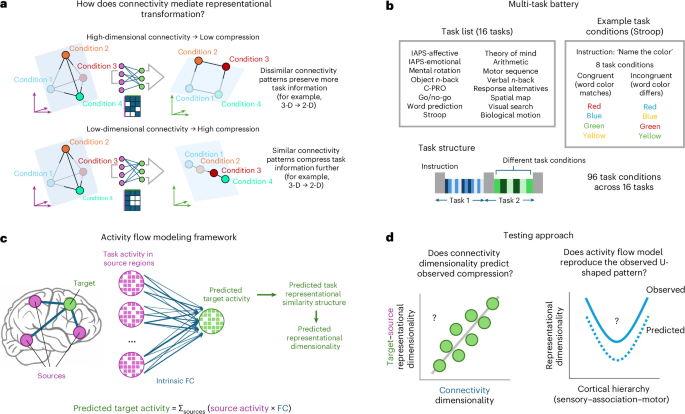
Flexible cognition requires the brain to generalize across tasks while preserving task-specific information. Previous work showed that task representations are compressed in the association cortex and expanded in sensory and motor systems, but the mechanisms underlying these transformations are unclear. Here we test whether the geometry of intrinsic brain connectivity constrains how representations change between cortical regions.
We analyzed functional MRI acquired during 16 diverse cognitive tasks together with activity flow modeling, finding that connectivity dimensionality predicts representational changes across the cortex. Low-dimensional connectivity compressed task representations and increased similarities across tasks, whereas high-dimensional connectivity expanded representations and supported conjunctive coding of task features. Activity flow modeling reproduced the observed compression-to-expansion pattern along the sensory–association–motor hierarchy and generated representational geometries that more closely matched targets than sources, consistent with transformation rather than transfer of information.
These findings identify network geometry as a systems-level principle that shapes cortical representations and supports flexible cognition. This is a preview of subscription content, access via your institution Access Nature and 54 other Nature Portfolio journals Get Nature+, our best-value online-access subscription Receive 12 print issues and online access Prices may be subject to local taxes which are calculated during checkout The activation maps and functional parcellations from the original study are available at http://www.diedrichsenlab.org/imaging/mdtb.htm. The raw behavioral and imaging data for the cerebellum are also available on the data sharing repository at https://openneuro.org/.
Example derivatives (representational and connectivity dimensionality values of all subjects) can be accessed at https://github.com/LakshmanChakravarthy/multitask_generalization/tree/master/example_derivatives. Source data are provided with this paper. The codebase can be accessed at https://github.com/LakshmanChakravarthy/multitask_generalization.
An integrative theory of prefrontal cortex function. Neurosci. 24, 167–202 (2001). Nakai, T. & Nishimoto, S.
Quantitative models reveal the organization of diverse cognitive functions in the brain. Article CAS PubMed PubMed Central Google Scholar Nakai, T. & Nishimoto, S. Representations and decodability of diverse cognitive functions are preserved across the human cortex, cerebellum, and subcortex.
Extract — continue reading at the source.


